Why Your Physical Inventory Doesn’t Match Your WMS: The Inbound Bottleneck
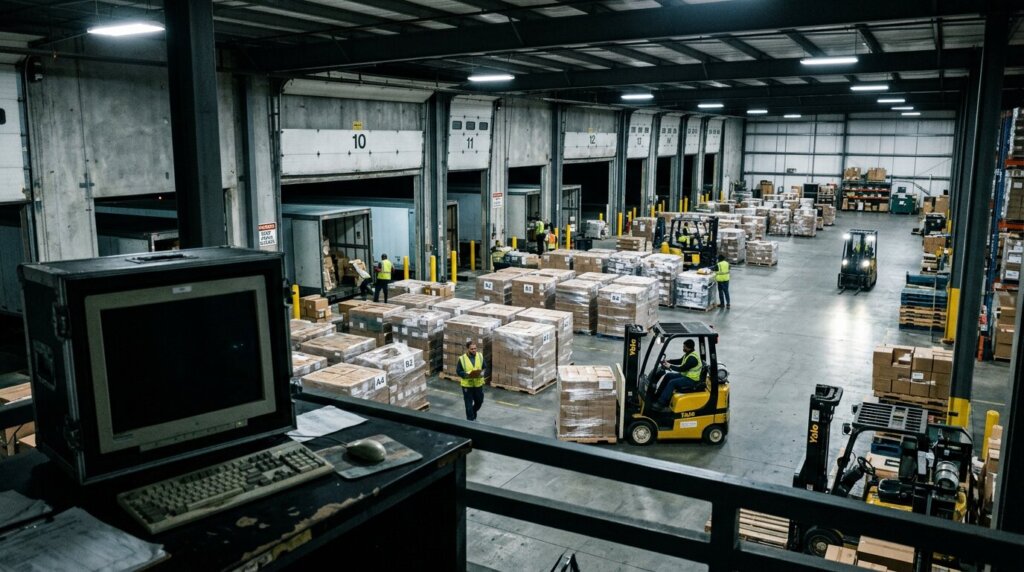
The gap between physical unloading and digital availability
The loading dock is packed with freshly unloaded pallets, and dock workers are walking the aisles with clipboards—yet the sales department’s system is flashing a red ‘out of stock’ warning. This scenario strikes at the heart of the dock-to-stock problem. The goods are physically inside the distribution center, but due to missing or delayed WMS goods receipt, they remain invisible to underlying systems and the rest of the organization. As an expert in logistics back-office outsourcing, we at DataMondial see this familiar bottleneck often. The result is a phantom shortage where you are forced to say ‘no’ to customers, even while the merchandise is literally within arm’s reach.
This phenomenon occurs because physical handling on the warehouse floor has a dynamic of its own, entirely separate from administrative processing. Warehouse staff are focused on unloading trucks on time to comply with strict schedules and driving-time regulations. Pallets are quickly dropped in a temporary transit area. The accompanying handwritten CMRs, supplier packing slips, and complex customs forms end up in a pile in the control room or on a team leader’s desk. Only when the dust has settled from the incoming trucks does the transfer from ink to bytes actually begin.
A Warehouse Management System (WMS) can only function as a bridge between operations and commercial sales after data entry is entirely complete. Without a finalized goods receipt in the WMS, the system cannot assign putaway locations, trigger quality checks, or release sales orders. Therefore, the delay in the inbound flow is much more than a simple matter of moving physical goods. It represents an administrative blockade that suspends your entire outbound logistics process.
Physical priority versus administrative lag
The pressure to clear the concrete floor for the next truck consistently overrides the need to register the shipment that just arrived. Forklift drivers and order pickers often operate within extremely tight time windows. A blocked dock means waiting drivers and penalties for exceeding loading and unloading times. As a result, priority instantly shifts to moving goods out of the way on the ground, leaving the paperwork lagging behind asynchronously. Workers on the floor naturally view administrative tasks as a secondary process to be handled later. This decoupling of the goods’ physical location from their digital status is the root cause of all subsequent data synchronization issues.
The domino effect on outbound flow and allocation
The lack of proper digital receipts in the WMS completely freezes outbound operations. Modern allocation algorithms are designed to reserve specific pallet locations and batch numbers at the exact moment of order intake. Even if incoming goods could theoretically be sold just fifteen minutes after physical arrival, the system will actively block the transaction as long as the digital confirmation is missing. Pick waves grind to a halt or generate incomplete tasks, resulting in customer orders waiting on partial shipments. Ultimately, a slow inbound data entry process doesn’t just stop at the receiving bay—it forces immediate and costly pauses across your entire delivery schedule.
Three hidden costs of asynchronous administration
The lack of synchronization between the warehouse floor and the WMS impacts operations in several measurable ways. This friction translates into immediate revenue loss, wasted warehouse capacity, and the bleeding of scarce labor hours into endless internal coordination. Analyzing these specific areas reveals how seemingly minor administrative delays ripple straight through the profit and loss statements of logistics service providers and wholesalers alike.
To put the ratio between physical handling and administrative standstill into perspective, consider this calculation. A trailer containing thirty-three pallets is physically unloaded onto the receiving floor in twenty minutes. The waybills and quality documents land in an inbox for manual processing. However, due to a seasonal peak and an understaffed back office, it takes four hours before an employee manages to accurately key the data into the WMS and digitally confirm the receipt. Only then does the system generate putaway instructions, allowing the actual physical transport to the high-bay racking, which takes another fifteen minutes. The total dock-to-stock lead time is four hours and thirty-five minutes. In this scenario, ninety-three percent of the turnaround time is caused purely by administrative waiting.
Cost 1: Phantom shortages and lost revenue
Triggering an ‘out-of-stock’ alert when products are physically present securely inside the distribution center creates an expensive paradox. E-commerce platforms and B2B customer portals communicate with live WMS data in real time. When a consumer or business partner hits a wall because the inventory counter reads zero, they will often pivot to a competitor during that very same browsing session. Even if the product is sitting unregistered twenty meters away on a loading dock or in bulk storage waiting to be processed, this system delay directly results in lost sales opportunities.
Cost 2: Physical bottlenecks and inefficient space utilization
Floor space in an operational center is a hard limit. Unregistered inbound shipments occupy valuable square footage in the cross-dock or receiving zone. As long as no data entry has taken place, the system cannot suggest an optimized storage location based on ABC analysis or weight weight-bearing properties. These stranded pallets block walking routes, slow down reach trucks, and make it impossible for the department to seamlessly offload the next inbound truck. A lack of registration directly hampers processing speed, forcing warehouse operators to handle goods twice simply to carve out room to maneuver.
Cost 3: Friction and wasted time in customer service
The communication loop between the back office and the warehouse devours invisible hours. When a customer service representative receives an inquiry about the delivery time of an urgent shipment, their starting point is the computer screen—which shows no record of arrival. What follows is a flurry of phone calls to the dock supervisor, physical hunts for missing forms, or walks across the shop floor to trace specific pallets. These constant status checks break the rhythm of warehouse operations and divert logistics personnel from their core tasks, resulting in substantial hidden labor costs.
Data entry capacity as a logistical bottleneck
The underlying cause of asynchronous inventory lies in the nature of processing requirements and the immense pressure placed on existing staff. Logistics is an industry driven by sheer throughput speed. Products must keep moving. Yet, the administrative side demands a contrasting approach. Entering best-before dates (BBD), traceable batch numbers per shipping unit, and complex HS codes for Customs requires meticulous, monk-like focus. The moment goods possess characteristics that vary by production line or carrier, the usefulness of standard database templates immediately plummets.
When back-office teams—often working static shifts—are hit with peak periods and the corresponding deluge of documents, overload is immediate. Companies sometimes attempt to bridge this capacity gap by pushing data entry onto the warehouse workers themselves, or by dropping temp workers onto the shop floor to handle screen work. Drivers and loaders, trained for heavy physical coordination, are suddenly rushing to key in long intake lists and intricate specifications. Haste leads to typos. Swapping a digit in a batch number or mistakenly translating a packaging unit from ‘outer box’ to ‘piece’ corrupts master data, immediately triggering erroneous inventory counts. The negative impact of personnel shortages on logistics back-office processes becomes painfully visible here.
The illusion of total automation
Technology is frequently championed as the ultimate savior, with barcode scanners and EDI integrations seemingly providing the perfect answer. However, operational reality proves that manual intervention and visual verification upon receipt remain absolutely essential. Many suppliers document shipments inconsistently. Fast-changing supplier networks lead to packing slips with damaged or illegible barcodes—or barcodes that simply don’t correspond to the warehouse’s own article database. Furthermore, customs documentation and quality controls often require direct human assessment or the consolidation of paperwork that cannot be entirely managed by machines. Human involvement, driven by logic and the ability to navigate exceptions, therefore retains a critical position in the process.
Error margins during back-office overload
A lack of focus during the goods receipt process causes tangible ripple effects in later stages. A minor mistake—missing a single line on a transshipment manifest—translates into a failed picking assignment later that afternoon. An order picker drives to the system-assigned bin, realizes the current count is off, and is forced to abort the order. The ensuing correction workflow demands hours from an inventory manager to dig up the original cause and track down the missing boxes. Rushed manual work during the inbound flow consistently pays itself back in multiplied correction time on the outbound side.
Scalable frameworks for a real-time flow of goods
Inventory visibility is a strategic priority that cannot be fixed overnight simply by implementing a software upgrade. Establishing a workable flow of goods that can withstand volume fluctuations requires strict frameworks. The foundational requirement is the physical separation of core tasks: shifting boxes belongs strictly on the shop floor, while granular data entry and careful verification belong in a centralized, calm environment—safely isolated from the peak pressure and roaring engines of the loading dock.
Back-office processes must be structured to effortlessly absorb seasonal peaks, such as holiday rushes or unexpected container arrivals. Within fixed internal overhead structures, this typically leads to uncontrolled spikes in personnel costs due to overtime, or the arduous process of onboarding specialized temporary workers. True operational scalability demands more flexible models, such as Business Process Outsourcing (BPO) or targeted nearshoring. In these setups, external, highly trained data teams shoulder the weight of administrative peaks, ensuring the organization only pays for operational capacity when freight volumes actually demand it.
Deploying RPA (Robotic Process Automation) in combination with a dedicated processing team massively accelerates this workflow. However, EU compliance must remain front and center here. To guarantee supply chain continuity and minimize risk, outsourcing requires ironclad assurances regarding data accuracy and strict data protection in accordance with European legislation. Ideally, data management should take place within the same trading time zone, utilizing data centers and processing teams that operate safely under the manageable, secure and compliant regime of the European Union.
When the dock-to-stock process features flawless registration, hidden labor costs plummet and physical goods align perfectly with the digital logic of system allocation. Consequently, data quality directly dictates the speed of handling on the dispatch floor. Companies that systematically secure this connection and boldly decouple administrative tasks from physical handling effectively take the brakes off their WMS, ensuring continuous reliability in their supply chain.
Is the gap between your system and the reality on the warehouse floor growing during peak periods? Discover how DataMondial utilizes scalable, EU-compliant nearshoring in Romania to efficiently structure your back-office processes and document processing, seamlessly guaranteeing real-time inventory visibility. Professional logistics back-office outsourcing with DataMondial is the key to unlocking true operational success. Contact us today to discuss optimization opportunities for your logistics administration.