Why a Single Missing Data Field Can Bring Your Air Freight Administration to a Standstill
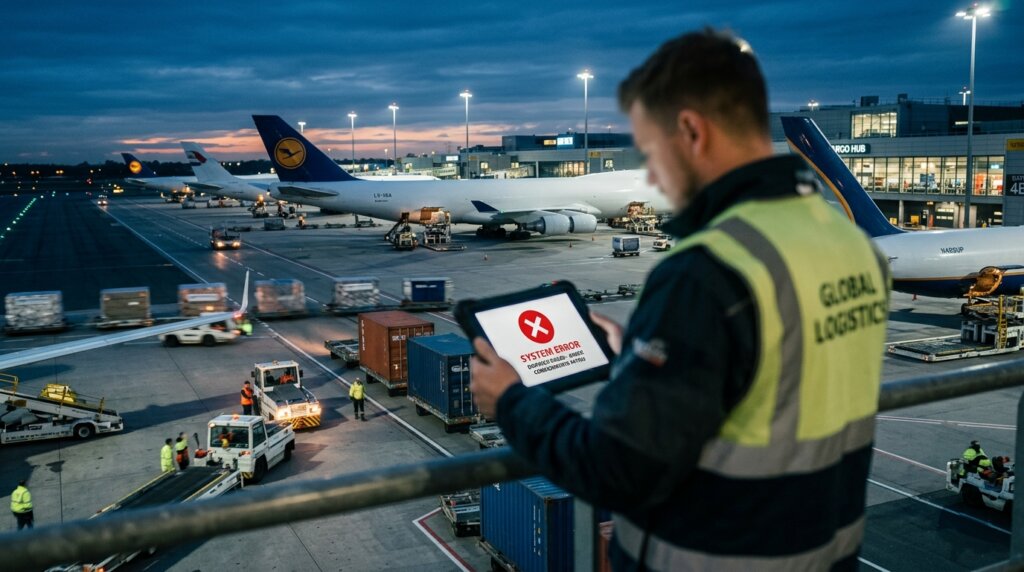
The domino effect of a single empty data field
A freight pallet loaded with high-value electronics sits idle on the airport tarmac. The handler scans the barcode. The system refuses to release the cargo. The root cause? A single missing field on the Master Airway Bill (MAWB). This scenario perfectly illustrates how a minor data gap creates a roadblock that tears straight through both the physical and digital supply chain. To prevent these delays, it is crucial to proactively cleanse or migrate your customer data.
Transport Management Systems (TMS) and customs applications are programmed for strict data validation. Internal systems simply do not accept half-finished files. A blank mandatory field triggers an immediate halt to automated workflows, forcing logistics staff into exception handling. The standard workflow devolves into an ad-hoc escalation process involving forwarders and carriers to manually track down and fill in the missing information.
Stagnating cargo releases and workplace escalations
Missing just one reference number creates a hard disconnect between the data flow and the physical cargo flow. Systems communicate via Electronic Data Interchange (EDI). When a mandatory parameter is left out of this digital exchange, the link breaks. The physical release at the airport stagnates instantly, leaving ground handlers without the authorized status required to move or transfer the cargo.
This standstill fuels congestion at the hub. Airport floor space is limited and fiercely expensive. Goods waiting on administrative clearance block precious storage capacity meant for incoming flights. Meanwhile, on the floor, the escalations begin. Planners and forwarders burn through valuable hours on phone calls and emails with international partners—battling time zones and language barriers—all just to populate a single data field.
The 3 most commonly forgotten fields in HAWB and MAWB documentation
Data-entry errors in air freight documentation follow a predictable pattern. The fields outlined below are systematically skipped or filled out incorrectly, leading to immediate bottlenecks.
- Specific Incoterms and delivery locations
Simply listing a general term (like DAP) without specifying the delivery city or postal code blocks the routing. This creates immediate confusion regarding the split of freight and customs charges between buyer and seller. - Harmonized System (HS) Codes
Missing or truncated commodity codes prevent mandatory pre-arrival customs declarations. Systems will not accept plain-text goods descriptions when a six- or eight-digit HS code is legally required for the clearance procedure. A lack of accuracy often results in freight documentation errors that disrupt the entire planning schedule. - Dimensions for Volume/Chargeable Weight calculation
Logging the gross weight without including the exact length, width, and height of the pieces is a critical error. Airlines calculate flight capacity based on chargeable weight. An empty dimension field halts the rating process and results in booking rejections.
The hidden labor hours of manual corrections
Operational management often views an unfilled document field as a minor administrative hiccup. Translated into hard currency, however, it is a massive operational leak. The Cost Per File (CPF) inflates with every minute an employee spends hunting down source data.
This wasted time creates a bottleneck effect in the back office. As the week progresses, document processing backlogs pile up, eventually culminating in intense peak pressure on Friday afternoons for departing weekend flights. The burden falls squarely on scarce, certified personnel. Their focus is forcibly shifted from proactive logistics management to repetitive digital repair work.
Impact on the Cost Per File (including a practical calculation)
The financial impact of exception handling becomes undeniable when measured against current operational rates. A back-office employee in the Benelux represents an average hourly rate of € 45 (including employer costs). This translates to € 0.75 per minute.
- Time spent: Flagging the error, locating the correct contact, drafting the email, waiting for a response, and updating the TMS takes an average of 15 minutes per file.
- Cost per incident: 15 minutes x € 0.75 = € 11.25 in extra processing costs per file.
- Volume impact: At a conservative estimate of 200 flawed air freight documents per week, hidden correction costs amount to € 2,250 a week.
Annually, this results in over € 115,000 in operational losses, dedicated purely to correcting incomplete data entry from external parties.
Turnover among scarce back-office talent
Certified logistics professionals, specifically trained in IATA guidelines and customs formalities, prefer to execute substantive, high-level work. Being constantly dragged into repetitive repair loops breeds frustration. Tracking down someone else’s errors inevitably leads to demotivation and torpedoes employee satisfaction.
In a job market where logistics specialists are incredibly scarce, repetitive administrative tasks act as an accelerator for staff turnover. Losing a trained forwarder brings steep recruitment costs, lengthy onboarding trajectories, and significant knowledge drain. Ultimately, this churn jeopardizes the continuity of the entire operational department.
Why modern systems crash from data gaps
Implementations of modern system solutions lean heavily on the promise of flawless digitalization. Platforms rely on Robotic Process Automation (RPA) or integrated TMS modules to accelerate throughput. Yet, these state-of-the-art systems fail the moment they are fed substandard source data.
Automated logistics software requires rigid input parameters. Triggers for customs clearance, invoicing, or transport orders activate only after passing full system validation. If the source data structurally features missing or incorrect fields, the process grinds to a halt. Without an autonomous, high-quality validation process preceding the automated flow, software cannot deliver ROI. Companies end up paying hefty licensing fees for systems that degrade into nothing more than expensive storage units for stalled files.
Standstills in RPA and automated clearances
RPA bots operate on conditional logic. They completely lack the contextual intelligence required to intuitively interpret a missing value. The very second a bot encounters an empty data field on an HAWB, its script terminates. The system simply cannot ping the customs application without the required tariff codes or weights.
The software instantly places the shipment in digital quarantine. This triggers a notification demanding human intervention. The projected efficiency gains of the RPA implementation evaporate overnight: the bot hasn’t eliminated manual labor; it has merely relocated it to a QA queue.
The hard boundary: Data supplementation or workflow redesign?
Correcting random document gaps internally is viable—as long as they remain isolated incidents. But a hard boundary is crossed when data gaps take on a structural nature. If a specific overseas agent sends invoices every week with the Incoterms mysteriously absent, manual data supplementation is no longer an adequate response.
At this tipping point, back-office data repair falls short. A fundamental workflow redesign is required. This means enforcing strict data restrictions at the gate, automatically rejecting and returning files to the sender if they do not meet compliance with EDI standards. Only when the root cause is shut down at the source can the process flow within the TMS actually be restored.
Prevent stalled shipments with foolproof documentation
The profitability of the air freight supply chain relies entirely on the availability and accuracy of source data. Manual data inquiries artificially inflate the Cost Per File, crash expensive RPA systems, and burn out your scarce logistics talent. DataMondial offers a targeted process scan to instantly reveal and close these operational leaks. Operating via nearshoring from Romania, our expert BPO team takes over repetitive documentation streams and TMS data entry, while guaranteeing strict 100% EU compliance. Do you want to structurally elevate the quality of your data flows? Have our specialists cleanse or migrate your customer data. Safeguard operational continuity and alleviate workload pressure by instantly offloading structural backlogs to DataMondial’s highly scalable back-office solutions.