Setting the Right BPO SLAs: Quality Standards for Logistics Data Processing
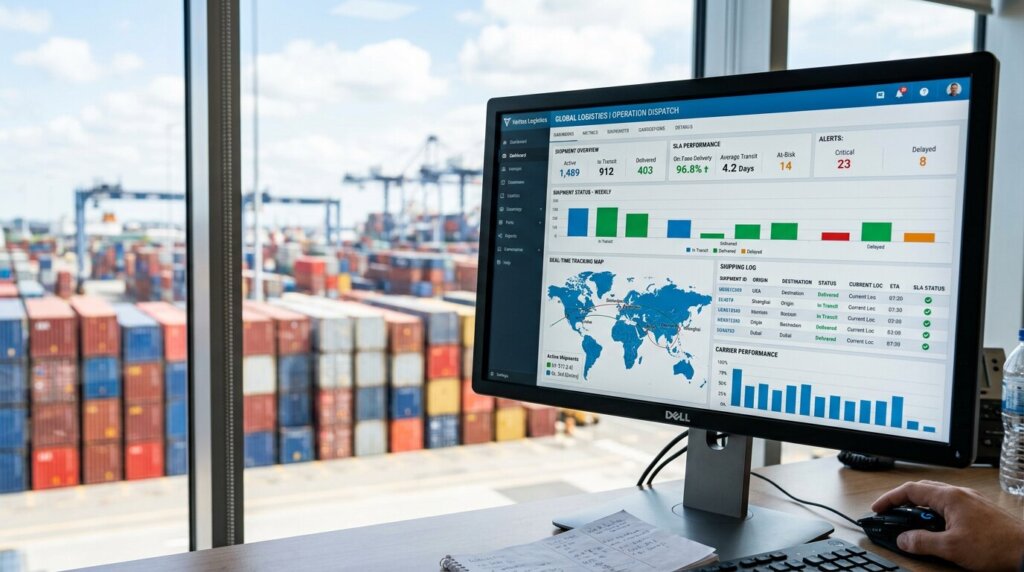
Standard service level agreements (SLAs) quickly fall apart in operational logistics as soon as the first seasonal peak hits. Trucks, ships, and trains do not wait for a sluggish back office. Terminals immediately block deliveries when documentation is incorrect. This requires specific performance indicators tailored to the logistics playing field, where high variability and efficient data processing – DataMondial dictate the standard.
Why standard SLAs fall short in freight forwarding and supply chain
Logistics processes are characterized by rapid volume leaps and unforeseen ad-hoc changes. Companies often work with static baseline contracts for their back office, based on a fixed number of hours or documents per month. As soon as factors like pre-Chinese New Year rushes drive up volumes, these contracts hit a wall. The ‘2024 State of Logistics Report’ by Logistics Management highlights how rhythmic volume increases lead to immediate bottlenecks and delays in outdated processing chains. Contracts must scale seamlessly with market demand. Companies that settle for static agreements pay the price in demurrage and terminal storage fees.
Variability in logistics volumes
A mismatch between fixed-hour SLAs and the reality of seasonal freight peaks results in massive operational backlogs. Freight forwarders process cargo based on client supply. This can mean a hundred documents on Tuesday and a thousand on Thursday. An agreement with a Business Process Outsourcing (BPO) provider that assumes an even daily distribution simply does not align with this dynamic. The McKinsey report ‘Transforming logistics with data and analytics’ argues that the capacity to respond to these ad-hoc volume changes is what separates a successful supply chain from a rigid one. The data stream must be scaled in hours, not weeks.
System uptime versus actual data accuracy
Standard IT SLAs lean heavily on metrics like 99.9% uptime. For a logistics BPO, this metric is entirely inadequate. An urgently needed input screen operating with perfect availability offers absolutely no value when the data operator repeatedly enters the wrong weight, incorrect HS codes, or makes freight documentation errors. UNCTAD’s ‘Review of Maritime Transport 2022’ concludes that such documentation errors lead to tangible supply chain delays of several days, right alongside the corresponding customs interventions. A proper logistics SLA positions processing accuracy as its primary criterion, downgrading standard uptime to a mere hygiene factor.
The 3 pillars of a controllable data processing agreement
Modern decision-makers build their vendor management structures on hard metrics, not just ‘best-effort’ clauses. Advanced logistics service providers anchor the quality of outsourced document processing into their frameworks through three clearly measurable pillars.
Measurable error margins as a hard ceiling
Data quality is the foundation. Requirements surrounding this quality are described in frameworks such as the ISO 8000 standard. For freight forwarding, customs clearance, and ocean freight, the measurable error rate functions as a strict upper limit in the processing agreement. A general guideline of 99.5%+ accuracy is the benchmark here.
A practical calculation from DataMondial demonstrates the financial impact of marginal differences: when processing 10,000 freight documents per month, an accuracy rate of 97% results in 300 documents with discrepancies. If a BPO partner improves this to 99.5%, that number drops to 50. Bridging the gap on these 250 incorrect documents doesn’t just save the logistics provider substantial amounts in recovery costs and fines; it actively prevents containers from being held up at port terminals.
Turnaround Time (TAT) linked to document type
Prioritization per document type is a contractual obligation. Rather than applying a blanket response time to all administration, a high-performing back office demands tiered processing times. Literature on ‘Call center quality assurance and metrics’ has stated for decades that layered response times drive efficiency. This applies equally to BPO:
- Time-critical documentation: (Customs declarations, container release notifications). Requires a maximum TAT of two hours.
- Standard data entry: (Receipt confirmations, warehouse inventory updates). Can operate with a TAT of four to eight hours.
- Archiving and invoice preparation: May fall within a standard 24-hour cycle.
By assigning distinct SLA timeframes per category, you create a system where urgent freight always takes precedence over basic administrative filing.
Securing volume upticks through scalability clauses
Peak volumes require contractual guarantees for scaling up without any loss of quality or degradation of the agreed TAT. A volume-uptick clause specifies exactly how the provider will react to growing flows. If the influx of waybills surges by 40% due to unexpected cargo, the contract defines within how many hours additional processing capacity goes live. Innovative service providers tackle this by deploying a combination of Robotic Process Automation (RPA) for rapid data extraction, paired with highly trained human-in-the-loop teams for validation and resolving complex exceptions.
Risk mitigation through geographic anchoring
The processing location stipulated in the BPO contract directly dictates legal and operational stability. Outsourcing personal information and sensitive client data across international borders brings strict compliance demands, where the choice of jurisdiction either introduces significant risks or eliminates them entirely.
Legal coverage in the country of execution
Regulators like the European Data Protection Supervisor (EDPS, regarding Article 28 GDPR) and the France-based CNIL continually tighten the rules for data transfers. Especially since the Schrems II ruling, transferring data outside of Europe comes with severe administrative hurdles, such as the obligation to conduct Transfer Impact Assessments (TIAs) and manage complex Standard Contractual Clauses. If an organization anchors its operational processing location entirely within the European Union, the entire chain immediately operates within the full legal framework of the GDPR. This saves the client from having to implement expensive, redundant control instruments to guard against data breaches.
European data security versus offshore vulnerabilities
The Deloitte study ‘Outsourcing to emerging markets: Risks and rewards’ illustrates the true cost-benefit realities. Outsourcing to uncertain third-party countries outside Europe is frequently accompanied by vulnerabilities in IT infrastructure, high employee turnover, and poor protocol oversight. Nearshoring via a Netherlands-based partner with an execution center in a European country like Romania restores the balance. The infrastructure aligns perfectly with Western security standards. Operational complexities related to time zones, language barriers, and business mentalities evaporate, all while operational overhead costs predictably decrease.
Escalation models: From detection to correction
When an SLA is at risk of being breached, excuses offer zero value to a client. A precise, actionable roadmap is required so it is crystal clear how the organization will respond. Contracts must concretely define how correction protocols are deployed entirely proactively—long before the terminal forces the supply chain to a grinding halt.
Establishing pre-defined trigger points
Subjective judgments about slow processing hold no value in a professional B2B partnership. Determine upfront the mathematical thresholds where contractual alarms must be raised. If the target TAT is 120 minutes, minute 90 should automatically trip the first trigger point, initiating internal escalation and scaling. The National Cyber Security Centre (NCSC) places heavy emphasis in its framework for ‘Making agreements with an IT supplier’ on the absolute necessity of recording and automating these mandatory response times. The external partner monitors the queue and initiates corrections before the actual deadline is ever crossed.
Actionable reporting in incident management
Clear communication flows ensure that data backlogs and documentation errors are resolved before trucks ever reach the gate. Established frameworks like the ITIL Incident Management process provide the ideal structure for escalations within operational departments.
Make a clear distinction:
- Functional escalation: Daily operations detect an anomaly. RPA specialists or the team lead of the nearshore hub resolve the specific roadblock (such as illegible characters on a Bill of Lading) immediately within the ongoing TAT, without interrupting higher-level management.
- Hierarchical escalation: Whenever there is a structural lack of capacity covering multiple document flows, the issue escalates to the operational management of both the service provider and the client to instantly scale up work hours and manpower.
By enforcing this distinction, dedicated teams resolve 95% of incidents collaboratively on the operational floor, guaranteeing continuous logistics flow.
A logistics organization will never outperform the data that feeds its internal systems. Static agreements block growth and slow down physical logistics movement; dynamic BPO contracts accelerate them. By implementing hard quality metrics, measurable agreements, and a strategic focus on EU compliance through structural nearshoring, forwarders and carriers legally and operationally secure their operational risks. Strengthen your competitive position by migrating your data processing – DataMondial into a highly scalable model. Start the conversation with DataMondial and request a capacity assessment today to determine exactly how a nearshoring solution can make your logistics back office highly profitable and exceptionally accurate.