Processing Goods Receipts: Internal Capacity vs. Structured Nearshore Data Entry
Processing Goods Receipts: Internal Capacity vs. Structured Nearshore Data Entry
The operational impact of delayed goods receipt administration
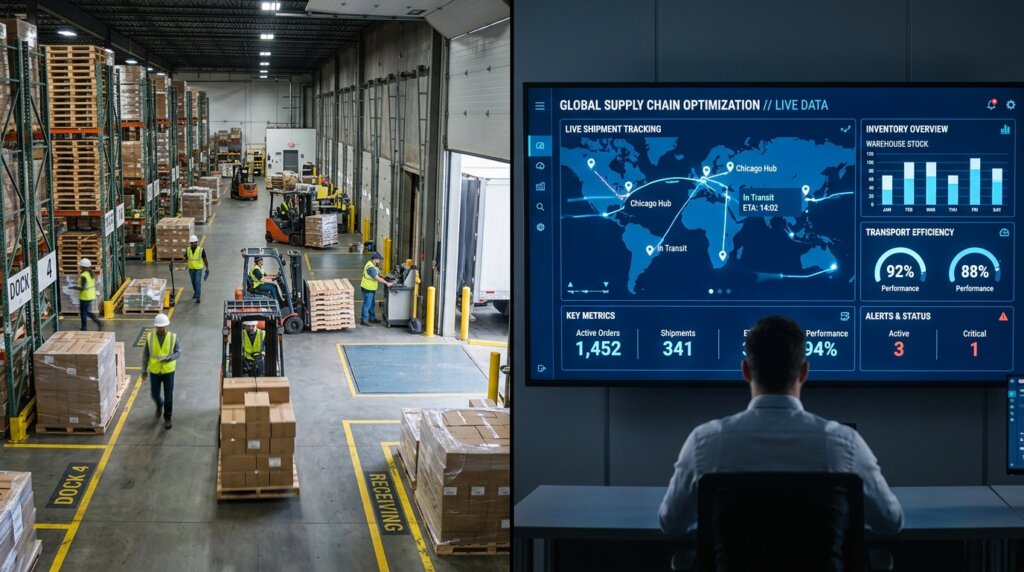
Physical goods waiting for digital registration bottleneck the flow within your Warehouse Management System (WMS). The moment a truck unloads at the dock, a discrepancy arises between the physical inventory on the floor and the registered stock in your systems. For businesses striving for maximum efficiency, logistics back-office outsourcing – DataMondial is a proven method to eliminate these administrative bottlenecks. A delay in processing Goods Receipt Notes (GRNs) leaves a trail of inefficiencies throughout the entire supply chain.
Operational data reveals a harsh logistical reality: tracing and correcting a flawed WMS entry after the fact takes three times longer than direct, accurate registration upon arrival. Incorrectly entered batch numbers, reported shortages of goods that are actually present, or wrong expiry dates force inventory managers into physical hunts through the racking. These corrective tasks drain productive hours straight from regular operations.
The gap between the dock and the digital system
Pallets cleared by customs or physically resting in the inbound staging area—but not yet entered into the WMS—effectively become dead stock. Order pickers cannot get clearance to move these goods. Planners base decisions on a system lagging behind physical reality.
This administrative backlog typically worsens toward the end of a shift. Staff pile up waybills, CMR documents, and packing slips in office trays, planning to bulk-process them later. In the hours between physical receipt and data entry, logistics service providers create blind spots for themselves and their clients.
Chain reactions impacting outbound performance
Delays at the front door inevitably impact lead times at the back door. Cross-docking processes fail when the WMS cannot instantly match inbound goods with outbound orders. Outbound trucks depart partially empty, leading directly to breached service level agreements (SLAs) and penalty clauses from end customers.
An incorrect or missing status registration triggers unjustified out-of-stock alerts in connected ERP or eCommerce systems. Sales teams miss orders because the system shows zero inventory, even while the items are literally sitting on the floor waiting for administrative entry. The hidden costs of these lost sales often far exceed the direct labor overhead of the logistics operation itself.
Option 1: Expanding internal back-office capacity
Immediately scaling up the internal administrative team is the traditional reflex to chronic delays in inbound receiving. The contours of this solution are obvious: the employer hires local staff, trains them on the specific WMS, and squeezes extra desks into the warehouse office.
However, the scalability of this model clashes head-on with the volatility of the supply chain. Volume spikes around the holidays or seasonal shifts demand temporary capacity, while permanent contracts lead to idle time during slower periods. Balancing staffing levels becomes a constant mathematical struggle where understaffing causes backlogs and overstaffing squeezes margins.
Local recruitment challenges and labor costs
The labor market for administrative logistics personnel is tight. Recruiting, onboarding, and retaining data entry specialists capable of flawlessly processing customs documents, packing slips, and ASNs (Advanced Shipping Notices) requires substantial HR effort.
Recruitment costs, employer taxes, absenteeism, and providing hardware and workspaces all drive up the cost per processed goods receipt. The moment a trained employee leaves the organization, valuable system-specific knowledge walks out the door, and the entire onboarding cycle starts from scratch.
The danger of task-shifting within the core team
When the pile of paperwork at the dock grows too high, warehouse managers often intervene by pulling floor staff behind computers. Experienced forklift drivers or order pickers are pulled away from their core tasks to rekey waybills into the WMS.
This ad hoc measure has two major drawbacks. First, the hourly rate of qualified warehouse personnel is higher than that of administrative staff, resulting in unnecessarily expensive data entry. Second, floor productivity dips, driving up loading and unloading times. Administrative work demands focus; an employee constantly bouncing between a forklift and a keyboard is structurally prone to making more typos.
Option 2: Structured nearshore data entry within the EU
Business Process Outsourcing (BPO) via a nearshoring model offers a compelling alternative to local capacity constraints. In this setup, a specialized, remote team located within the European Union adopts the exact data entry protocols of your logistics operation. Situated in countries like Romania, these centers operate in aligned time zones (CET/EET) and eliminate both cultural and linguistic barriers.
This model does not operate as an opaque ‘black box’ where documents vanish, but rather as a digitally integrated department. Strict adherence to European GDPR safeguards commercial client data, freight rates, and customer information. This provides a legally secure foundation that offshore alternatives outside European jurisdiction simply cannot match.
Synchronous WMS access without batch delays
Processing occurs in sync with the physical operation. Through a secure VPN tunnel or a cloud-based SaaS connection, the external team works directly within your existing system.
As soon as the truck driver hands over their documentation at the security gate, the receiving clerk scans it. These documents appear in real time on screens at the Operations Center. Data entry happens concurrently while forklifts unload the goods. By the time the pallets are racked, the administration is complete, and the stock is released into the WMS. There are no sluggish end-of-day batch uploads.
Combining RPA and human oversight
Efficient processing requires a blend of technology and human intervention. Robotic Process Automation (RPA) handles standardized, digital data streams. Automated scripts flawlessly ingest ASN messages and proactively match them to anticipated purchase orders.
When documentation is irregular, technology takes a step back and human expertise steps in. Smudged, handwritten CMRs, non-standard packing slips from new suppliers, or missing HS codes require contextual insight and domain-specific logistics knowledge. Staff pinpoint these errors, execute manual corrections in the WMS, and flag issues for the local warehouse manager via a standardized escalation pathway.
Decision framework: Which approach suits your warehouse?
The choice between internal expansion and a nearshore partner demands a rational system analysis and an honest look at daily volumes. Scale dictates feasibility. Operations processing fewer than fifty inbound line items or freight documents daily typically fall below the threshold. In that scenario, the time and IT infrastructure required to securely set up remote access do not outweigh the benefits. Once above this threshold, the model flips, and scalability immediately starts generating process efficiency.
Cost and scalability matrix
The financial models of these two routes show fundamental differences in structure and flexibility. The matrix below benchmarks operational variables against the chosen setup.
| Criterion | Internal back-office capacity | Nearshore EU data entry |
|---|---|---|
| Cost structure | Fixed monthly payroll (including employer taxes, pensions, and workspace) | Variable based on units, output, or agreed partial FTE percentages |
| Response to seasonal peaks | Hiring temp workers (premium rates) or paying mandatory overtime | SLA-driven scaling leveraging the BPO partner’s buffer capacity |
| Continuity risk | Delays due to local absenteeism or sudden staff turnover | Guaranteed capacity via shared pools of trained data analysts |
| Quality assurance | Dependent on individual employees and random spot checks | Regulated validation, systematic four-eyes principle, and nested RPA checks |
Checklist: 5 technical requirements for remote WMS entry
Before an external partner can take ownership of goods receipt, your local IT architecture must establish the following foundations:
- Secure gateways: Support for a Site-to-Site VPN, Multi-Factor Authentication (MFA) Citrix environment, or an accessible SaaS portal for WMS connectivity.
- Role-Based Access Control (RBAC): The system must allow specific roles (e.g., ‘Data Entry Clerk’) where read and write permissions are strictly limited to the receiving module, isolating access from financial master data.
- Digital workflow at the dock: Physical documents must be digitized immediately upon receipt via high-speed document scanners, linked to a shared network drive or cloud directory via IP whitelisting.
- Clean item master data: The master data registry in your ERP/WMS must be correctly structured. Remote data entry stalls when item numbers cannot be unambiguously matched to inbound physical goods.
- Defined escalation protocols: A digital ticketing system or structured workflow for managing deviations, shortages, and damages, ensuring that communication between the dock floor and the remote team remains fully traceable.
Data accuracy at the front door determines operational relevance and delivery reliability at the back door. Growing organizations seek solutions where capacity scales seamlessly with freight volumes, entirely bypassing the need to continuously inflate fixed overhead costs.
DataMondial translates this exact requirement into practice. Leveraging specialized BPO teams in Romania, we process complex documentation streams and manage WMS entry for logistics service providers across Europe. As a Dutch partner, we merge the speed of RPA with acute human logistics insight via secure, GDPR-compliant frameworks. Structured logistics back-office outsourcing – DataMondial delivers the stability and scalability that modern warehouse operations demand. Contact us to evaluate how we can accelerate and digitize your specific goods receipt processes.