The Administrative Chaos of LCL Shipments: Why Consolidation Cripples Your Back Office
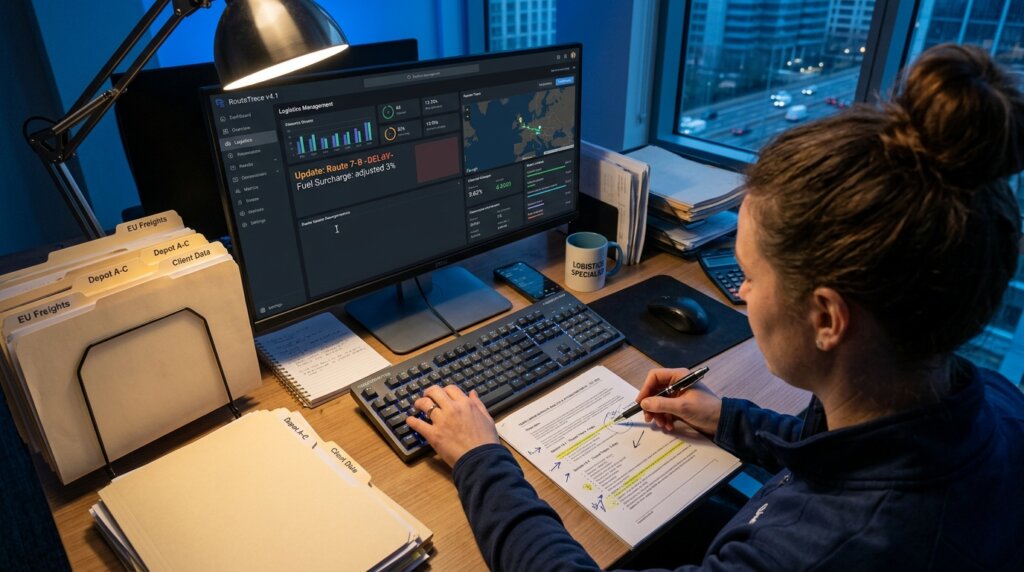
The Hidden Costs of LCL Consolidation
LCL (Less than Container Load) consolidation presents logistics service providers with an operational paradox. While it lowers freight costs per cubic meter and optimizes container capacity, it also triggers a disproportionate increase in administrative workloads. While management focuses on margin improvements on the procurement side, strategic logistics back-office outsourcing – DataMondial can prevent operations from bogging down in uncontrolled document flows.
The discrepancy between FCL (Full Container Load) and LCL is fundamental. As the analysis FCL and LCL: Understanding Cross-Border Shipping points out, an FCL file follows a linear data structure: one shipper, one consignee, one customs document. With LCL shipments, this model breaks down. Multiple partial loads are consolidated, resulting in an exponential increase in packing lists, commercial invoices, and House Bills of Lading (HBLs). According to the overview What Does LCL Mean and Why is it Important?, this multitude of documents creates a blind spot for executives. Sea freight savings are quietly wiped out by the operational hours required to process, validate, and correct the accompanying paperwork.
The Anatomy of an LCL File: Asymmetrical Data Entry
LCL documentation structurally deviates from standard import flows. Here, a single container doesn’t represent a single shipment, but rather a collection of administrative islands. This asymmetry immediately demands a multiple of processing hours. At the top of the file sits a single Master Bill of Lading (MBL), issued by the shipping line. Beneath it hang dozens of HBLs, issued by the freight forwarder or NVOCC (Non-Vessel Operating Common Carrier).
This influx of fragmented data creates a chaotic mix of formats. Forwarders receive data via unstructured PDFs, standalone Excel spreadsheets, emails with scanned faxes, and manually typed specifications in the body of messages. The publication Learn About Air Freight Containers and Ocean Freight LCL Shipping emphasizes that this fragmented delivery is the root cause of administrative bottlenecks and operational delays. Furthermore, The Freight Forwarder’s Guide to LCL Consolidation Best Practices demonstrates that discrepancies between the MBL and the underlying HBLs are a constant source of errors.
Below is an overview of common discrepancies found in consolidation files:
Data FieldMBL (Container Level)HBLs (Partial Load Level)Common DiscrepancyWeightTotal gross weight (VGM)Weights per batchSum of HBL weights does not match the MBL totalVolume (CBM)Total volume of the containerVolume per individual shipmentRounding differences lead to billing errorsCargo Description“Consolidated Cargo” (general)Specific product descriptionsTranslation errors or incomplete descriptions for customsIdentified PartiesNVOCC as Shipper/ConsigneeActual buyer and sellerIncorrect naming blocks final release
The One-to-Many Relationship Breaks Linear Processing
The linkage between one MBL and multiple HBLs fragments your control mechanisms. While a forwarder can close an FCL file after a single review cycle, LCL requires an iterative process. Each underlying HBL has its own lifecycle, complete with corresponding certificates of origin, packing lists, and commercial invoices. The source article LCL Shipment: Why ‘Cheap’ is Often Expensive illustrates that validating a consolidation container can actually mean running twenty separate validation rounds in practice. The overall file is only operationally complete when one hundred percent of the partial unloads are administratively correct.
Unstandardized Source Data
Consolidation brings together invoices from dozens of different suppliers worldwide. This source data is rarely standardized. Company A provides a fully digitized, EDI-linked packing list. For the same container, Company B submits a handwritten, crookedly scanned commercial invoice. The freight forwarder bears the burden of manually entering this unstructured data stream into their internal Forwarding Management System (FMS). This results in a time-consuming translation process where operational staff act as data entry typists rather than supply chain directors.
The Chain Reaction of Incorrect HS Codes in Consolidation
Customs formalities represent the hardest boundary for LCL shipments. A single incorrect data line in the customs declaration of a partial load will block the entire container. Coordinated LCL logistics relies entirely on the accuracy of commodity codes (HS codes). If a code is missing on Party C’s invoice, the goods belonging to Parties A, B, and D are going nowhere.
According to the market analysis 5 Mistakes Companies Make with LCL Freight to the US regarding US import reporting, mismatches in volume and weight trigger immediate customs holds. Border authorities shut down the physical flow until the paper trail matches up perfectly. Resolving missing HS codes requires communication with suppliers and importers across multiple time zones.
The Shared Risk of Consolidation
LCL is a model of shared logistics costs, coupled with shared operational risk. Cargo is shipped in a single steel box without physical partitions. When customs decides to conduct a physical inspection due to a misclassified pallet of electronics, the doors open for the entire container. Even importers with flawless track records end up facing delays as a result. This interconnected documentation makes strict, upfront data quality an absolute operational necessity.
Ad-Hoc Detective Work and Demurrage
Back-office teams quickly become entangled in unplanned detective work following a customs inquiry. Existing files must be reopened and source documents cross-referenced once more. This process is inherently reactive: it happens while the container is already sitting on the quay. The port’s clock is ticking. Wait times immediately escalate into demurrage and detention charges. Insights from LCL Shipment: Why ‘Cheap’ is Often Expensive reveal that terminal storage costs can quickly spiral so high that they completely overshadow the initial savings gained from consolidation. The margin your procurement department calculated vanishes directly into the terminal operator’s pockets.
Freight Costs vs. Back-Office Hours: A Disrupted Balance
Clinging to the manual processing of LCL shipments causes both financial and operational losses. Managing solely on ocean freight procurement rates ignores the actual operational costs of production. To keep the profitability of logistics operations in balance, a broader calculation model is required. The publication Leveraging Digital International Solutions to Simplify Complex LCL Consolidations explicitly points to data entry as the hidden cost center in cross-border transport.
Consider this scenario: a freight forwarder consolidates shipments and saves €450 in pure ocean freight compared to alternative LTL (Less than Truckload) or partial load models. The container holds sixteen different HBLs. Manually validating, retyping data into the customs system, requesting missing HS codes, and booking the sixteen separate invoices takes the administrative department 5.5 hours. At an internal hourly rate of €40 (including social charges and overhead), this processing costs €220. Scaling up incoming volumes simply demands more FTEs. In a tight labor market with a historic shortage of logistics personnel, this model is unsustainable. Companies simply cannot recruit accurate staff fast enough.
The Illusion of LCL Margins
The calculation model above exposes the illusion of consolidation margins. While the numbers on the freight quote look favorable, profitability steadily erodes on the work floor. Administrative processing time grows linearly with the number of partial shipments, effectively strangling the internal efficiency gains of large-scale ocean freight. Furthermore, the costs of retroactive error detection—through additional assessments or customs fines—can quickly turn a seemingly profitable shipment into a loss-making file.
The Scalability Limit
Assigning specialist freight forwarders internally to retype HBL data is a severe misallocation of expertise. These professionals possess highly specific logistics skills: instructing carriers, navigating complex customs issues, and maintaining client relationships. Deploying them as data entry typists for routine LCL documentation hits a company’s scalability limit head-on. True growth requires highly trained specialists to focus on exception management and process optimization, not copying container numbers from PDFs into the TMS. The Freight Forwarder’s Guide to LCL Consolidation Best Practices agrees that scalability in forwarding only materializes when repetitive data streams are decoupled from primary logistics problem-solving.
From Consolidation to Administrative Complexity
The asymmetry between the Master Bill of Lading and multiple House Bills of Lading turns LCL consolidation into a document-intensive process where unstructured source data guarantees manual delays. Erroneous data points, such as incorrect HS codes, distribute operational risk across all partial shipments and trigger costly wait times at terminals. Margins achieved in procurement are subsequently lost in the back office to repetitive corrections, proving that locally scaling manual data entry is an organizational dead end.
For logistics service providers aiming to guarantee scalability without compromising data quality, DataMondial provides the necessary operational infrastructure. As a Dutch BPO company with specialized nearshoring facilities in Romania, DataMondial takes over repetitive documentation workflows and data entry—fully compliant with EU guidelines. Want to know how logistics back-office outsourcing – DataMondial can relieve your experienced forwarders and protect your consolidation margins? Explore DataMondial’s robust back-office solutions and start building a scalable operational foundation today.