How Unvalidated Container Data Sabotages Your Multimodal Transport Planning
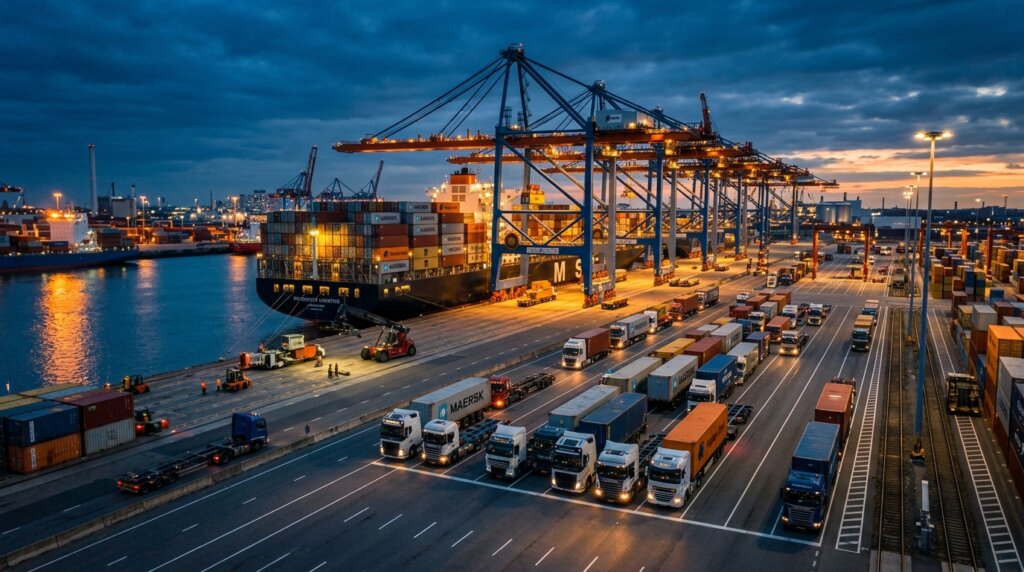
The chain reaction of flawed ETA updates
A single incorrect entry in an Estimated Time of Arrival (ETA) triggers an immediate disruption across the entire multimodal routing schedule. Companies route thousands of sea containers through international networks every week, relying on a tightly orchestrated sequence of transport modes. The moment a shipping line’s source information deviates from physical reality, this chronological planning collapses. Carriers schedule equipment based on expert data validation for OCR and AI that is no longer accurate. Research by Statistics Netherlands (CBS) on “The Container in the Logistics Chain” confirms that fragmented registrations and missing status updates cause structural damage to punctuality within logistics hubs.
From a misplaced typo to a missed rail connection
Propagating raw, unchecked data through the supply chain follows a destructive pattern when validation is lacking. Each step amplifies the operational damage:
- Data corruption at the source: A vessel experiences offshore delays or deviates from its scheduled route. The shipping line either fails to push the ETA update to the network or transmits it in an incompatible format.
- Terminal bottlenecks: Drivers arrive according to the original freight schedule. The container is either physically missing, not yet discharged, or lacks the necessary customs clearance.
- Idle times and lost capacity: Trucks block loading docks or idle in waiting areas. The driver’s daily schedule immediately falls behind.
- Multimodal connection failures: The delayed cargo misses its scheduled transfer to the reserved barge or rail slot. The multimodal chain breaks at the handover point.
- Forced ad-hoc solutions: Planners shift into damage control. To guarantee contractual delivery times for end customers, they immediately book more expensive, standalone road transport alternatives—decimating the margin per shipment.
The administrative aftermath for the back office
This operational disruption translates almost instantly to the office floor. Planners and back-office staff abandon their core tasks to trace the shipment’s physical location. They call terminals, email carrier agents, and manually scour various shipping lines’ login portals. These frantic searches for the actual cargo status drain hours of productivity. This manual repair work sidelines structural process improvements and spikes the workload across the entire team.
Why raw carrier APIs pollute your planning systems
Data transmission does not guarantee data quality. Digital exchange protocols like APIs or EDI connections simply function as conveyor belts for information. Blindly pulling data from multiple shipping lines injects mixed formats and entry errors directly into your Transport Management System (TMS). The TNO report “Construction of Multimodal Transport Chain Data” concludes that robust validation rules are essential to halt error propagation across interconnected logistics networks. Without a controlling filter, the problem merely speeds through your company’s systems faster.
The illusion of flawless EDIFACT connections
In the maritime industry, shipping lines often apply their own interpretations of the international EDIFACT standard. Relevant data fields vary in length, date formats differ by continent, and location codes (UN/LOCODE) are applied inconsistently. When a freight forwarder or carrier imports these divergent data streams without normalizing them first, an illegible dataset pollutes the operating system. A system error might misinterpret a date format (MM/DD/YYYY versus DD/MM/YYYY), while human entry errors—such as an extra space in the container number during bill of lading (B/L) creation—permanently block the matching process between the shipping line and the terminal.
The danger of blind automation
Systems process information based purely on programmed permissions. Without a logical validation layer, the TMS accepts any technical value that fits the required string length or data type. This litters planning boards with physical impossibilities: ETA statuses locked in the past, or cargo reported at the port while its customs status remains “pending departure.” Blindly accepting these values triggers downstream automated processes. Billing systems generate draft invoices for undelivered services, and fleet managers reserve trips for phantom cargo.
Demurrage, detention, and lost capacity
Inconsistent arrival and departure times directly hit your P&L statement. Release dates are mostly tied to the original ETA, even though the container’s physical arrival might happen days later. If the TMS fails to detect or correct these asynchronous statuses, the free-time clock starts ticking prematurely. Forwarders and carriers are subsequently hit with demurrage invoices (even while the container was inaccessible at the terminal) and detention charges (when returning empties is thwarted by documentation errors).
The hidden costs of invisible containers
Capacity uncertainty forces logistics planners to manage costs using artificial time buffers. To prevent fleets from arriving empty-handed at the terminal, they schedule return trips or pickups much later than operationally required. As a result, sea containers occupy physical terminal or warehouse space longer than necessary. On a macro level, this defensive scheduling strategy lowers daily yields. Trucks complete fewer turnarounds per calendar month. Fleet capacity effectively shrinks—purely as a reaction to unreliable forecasts.
Real-world impact: Penalties per unvalidated container
Financial models clearly expose this bleeding. Imagine a transport company scheduling 500 import containers for hinterland transport each week. An anomaly or missing error detection affects 5% of these shipments. That means 25 containers per week are delayed due to erroneous status updates or missing terminal integrations.
Delayed information updates quickly cause equipment to exceed the agreed free-time by two days. At a standard detention and demurrage rate of €125 per day, direct charges mount to €250 per affected unit. For 25 containers, this translates to €6,250 a week. Stretched over a year of operations, this kind of data leak results in hundreds of thousands of euros in entirely avoidable penalties.
When automated tracking falls short
Standard data integrations deliver stable results in linear, one-dimensional processes. Purely local point-to-point road transport with a single carrier involves a uniform data stream. However, multimodal routes introduce multiple data sources, international regulations, and physical transshipment nodes. In this highly dynamic environment, basic automation quickly hits its structural limits. The margin of error grows exponentially as more actors enter the supply chain.
The limitations of Robotic Process Automation (RPA)
Robotic Process Automation successfully executes strictly defined data entry tasks: copying value X to field Y based on fixed parameters. Yet, in complex customs environments, exception handling fails entirely without specialized domain knowledge. A single anomalous value on an import document results in hard locks by customs authorities. An RPA script might flag the rejection, but it lacks the analytical capacity to actively correct a flawed HS code, an expired VAT number, or missing certificates of origin. Releasing the cargo requires the cognitive assessment and intervention of an operational professional who truly understands specific customs regulations.
Build a protective validation layer for your TMS
A robust system evaluates, filters, and verifies information long before it ever impacts your operational schedule. A hybrid setup—coupling scalable technology with strict human protocols (human-in-the-loop)—restores structural control over your multimodal itineraries. This immediately upgrades your data accuracy and safeguards operational continuity. Before diving in, it is essential to conduct a proper cost-benefit analysis for AI projects and data outsourcing.
DataMondial, your premier BPO and validation expert, combines Dutch logistics management with highly efficient, privacy-secured nearshoring in Romania (EU). Map out your hidden data leaks and capacity losses in detail, and discover the measurable optimization steps for your organization. Request our targeted process scan—including a detailed cost-benefit analysis—today, and regain total control over your TMS data by opting for structural support in data processing and validation.