The Danger of Certainty: Uncovering the Hidden Risks of False Positives in Logistics OCR
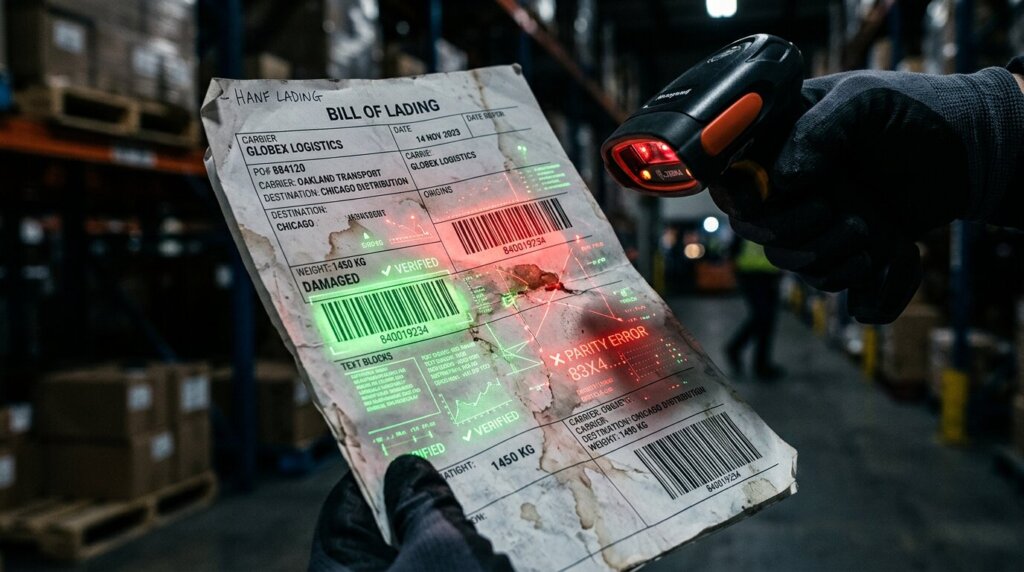
The Operational Contrast: OCR Rejections vs. Silent Read Errors
A truck driver reports to the terminal to pick up a shipping container and follows the system instructions to a specific spot in the yard. Upon arrival, however, the designated location is empty. The root cause occurred days prior in a back office: an Optical Character Recognition (OCR) engine misinterpreted a ‘G’ on a crumpled Bill of Lading as a ‘C’. This is a classic example of a silent read error (false positive). The digitization system classified the anomalous data as accurate and forwarded it to the Warehouse Management System (WMS) without triggering any alerts.
Organizations are increasingly relying on automation, but in doing so, they inadvertently build in blind spots. Direct EDI or XML connections transmit clean datasets within strict parameters. However, the transition from physical paper scans or unstructured PDFs to usable data is exactly where silent data corruption occurs. A completely unreadable scan immediately triggers quality barriers; the system blocks the input and forces exception handling. A silent transcription error, by contrast, bypasses these gates completely unnoticed. The error infiltrates the database and embeds itself in the core layer of logistics operations. High-quality data validation for OCR, AI, and machine learning is therefore essential for a reliable process.
Error Messages Are Safer Than False Certainty
An explicit error message pauses the workflow. Input is frozen until human validation takes place. While that specific document gets delayed, the integrity of the master data in underlying systems remains completely intact. But when an engine writes an incorrect number or an anomalous code to the server with absolute system confidence, control mechanisms vanish. The entire logistics planning process starts reacting to a manipulated reality.
In many operational setups, speed takes precedence over precision. Aligning processes around corrupted container numbers, false weights, or incorrect unloading addresses creates exponential deviations further down the supply chain. A temporary halt due to uncertainty acts as a necessary fail-safe, whereas blind acceptance ultimately forces terminal gridlocks. To make this process scalable, you can utilize an exception handling framework that structures OCR fallout effectively.
The Chain Reaction of Corrupted Control Data
A single-letter deviation in control data initiates a chain reaction across multiple systems, leading to operational stagnation. On the shop floor, numbers and letters translate into crane movements and truck schedules. Incorrectly registered reservation numbers force terminal staff into extensive manual and physical searches across hectic yards.
Customs processes demand an exact match between freight documentation and digital declarations. Incorrectly extracted HS codes on import documents block border clearances or result in fiscal penalties; a single divergent digit can suddenly place a duty-free product into a taxed category. Proactive validation at the front door costs a mere fraction of reactive recovery later. Subsequent correction costs are often a factor of ten or higher, as various departments must identify the discrepancy, secure the asset, manually correct the data, and resubmit it administratively.
Physical and Financial Impact on the Terminal
Flawed input data at the logistics gate translates directly into delays in the underlying storage yard. Automated cranes are programmed for scheduled freight, but abort their operations if the actual container number does not match. Drivers and trailers bottleneck the flow while paperwork is manually verified at customer counters.
Early data corruption on a digital form often only reveals itself in practice at the exact moment of physical handover. This specific moment of standstill generates wait fees, mounting parking costs, and billable demurrage and detention charges.
Calculation Example: The True Cost of a ‘1’ Turning Into an ‘I’
A single unnoticed transcription error translates this chain reaction into concrete, avoidable charges. The calculation below demonstrates how the absence of human validation scales from the desk to the dock.
| Phase | Activity / Consequence | Average Financial Impact |
|---|---|---|
| Prevention | Proactive desk validation of control data at weak points | € 0.50 (Base cost) |
| Administrative Correction | Manual data fix immediately after a processed import error | € 5.00 (10x increase) |
| Phase 1: Manifestation | Truck blocks the gate due to an unknown prefix | € 15.00 (Waiting fee per interval) |
| Phase 2: Escalation | Terminal staff conducts a physical inventory on site | € 45.00 (Labor hours) |
| Phase 3: Aftermath | Demurrage fee stemming from missed pickup slot (day 1) | € 100.00 |
Why Current Algorithms Fail on Logistics Documents
Software developers’ marketing materials boast recognition rates exceeding ninety-nine percent. However, these laboratory statistics collapse under the pressure of the international supply chain. A 2025 analysis by market researcher Docsumo shows that a much higher error margin applies to complex and heterogeneous input documents.
Globally, waybills, packing slips, and customs forms rarely rely on a tight, uniform, and digitally native format. Algorithms trained on standardized templates struggle with suboptimal source documents in daily logistics operations. Publications by Vao confirm this structural contrast between developers’ ideal testing conditions and the reality faced by freight forwarders. A concrete stumbling block within OCR software is the lack of supporting middleware tailored to specific logical contexts. A standard recognition engine simply translates the encountered pixels into text strings, without verifying if the output is workable within port validation rules or routing codes. This is why many companies opt for hybrid document processing solutions to drastically increase accuracy.
The Reality of Battered Transport Documents
The intense journey of manifests and sea freight documentation degrades data quality well before the scanner is even reached. Physical handling during intermodal transport creates noise. Deep folds and creases slice crucial barcodes right down the middle. Port workers and customs officials frequently stamp clearances directly over essential shipment text.
Local scanners at decentralized warehouses digitize documents with highly variable DPI quality or feed them in skewed. Character recognition technologies attempt to decipher characters based on the surrounding reference context. As soon as ink stains, handwritten notes, and poor edge lighting break this structure, the percentage of false positive registrations steadily escalates.
Top 5 High-Risk Character Confusions
The character sets below systematically generate unnoticed structural errors when extracting container numbers, customs data, and trip numbers from unstructured documents.
| Visual Character on Paper | System Reading (Silent Error) | Typical Cause in Document |
|---|---|---|
| O (Capital Letter O) | 0 (Number Zero) | Often misinterpreted in the four-letter prefix of container numbers. |
| I (Capital Letter I) | 1 (Number One) / l (Lowercase L) | Stems from dense typography (sans-serif) on reference invoices. |
| 8 (Number Eight) | B (Capital Letter B) | Occurs on heavily printed or overexposed waybills. |
| 5 (Number Five) | S (Capital Letter S) | Weathered, faded, or low-resolution scans. |
| Z (Capital Letter Z) | 2 (Number Two) | Inconsistencies when drivers write manual corrections over printed text. |
Safeguarding Data Integrity: The Limits of Automation
The technical ceiling in automatic pattern recognition forces freight forwarders to structurally shield their data through hybrid processing. Transitioning to a process design that incorporates a ‘human-in-the-loop’ (HITL) methodology resolves the performance loss where software stalls. Research by Infrrd, cited by Parseur in automation analyses, demonstrates that strategically adding human validation invariably pushes document workflow accuracy securely above 95% and significantly curtails ultimate correction costs.
Within this setup, data elements with mediocre confidence scores no longer flow into transport planning systems; instead, they are escalated to trained data specialists. Integrating internal structures to categorize OCR fallout creates a process that retains speed without sacrificing integrity. Nearshoring facilities within the European Union provide logistics service providers with direct access to targeted operational domain knowledge and the capacity required to scale this manual verification work.
Human-in-the-Loop (HITL) as a Filter
In high-risk sectors, digitalization mandates a human shadow process. OCR technologies combined with Robotic Process Automation (RPA) handle the high-volume tasks: selecting, reading, and indexing unambiguous fields. But the moment character recognition on a complex detail drops below a pre-set confidence threshold, the workflow refuses automatic throughput.
That specific detail is isolated and routed to the screen of a validation specialist. This employee assesses the logical context of the isolated image (snippet) and correctly manual-inputs the data if necessary. This targeted interaction between engine and human guarantees data accuracy and keeps flawed values completely out of sensitive FMS (Freight Management System) and TMS (Transport Management System) environments.
Local Assurance and Compliance
Structuring and unlocking raw identification data, customs details, and manifest information requires a highly secure ecosystem. When considering Business Process Outsourcing (BPO) for this data management, responsibility crosses physical borders.
Establishing nearshoring teams at locations within Europe, including permanent facilities in Romania, guarantees contractual security. Processing and storing data in full compliance with GDPR (General Data Protection Regulation) ensures that privacy-sensitive control data never leaves protective European jurisdiction. This provides robust assurance to auditors, limits supply chain risks, and offers far more contractual certainty than intercontinental offshore outsourcing.
Conclusion: Validation and the Next Step in Data Integrity
The logistics industry only functions smoothly when assets are precisely steered by flawless underlying identifications. An error margin during data extraction invariably manifests as operational stagnation further down the line. The validation rules built around a reading system determine exactly how much friction the ultimate operation will experience at the terminal. Make sure your recognition process is thoroughly tested against the actual imperfections of document flows on the shop floor. Schedule a comprehensive data scan with DataMondial today, uncover the hidden bottlenecks in your back office, and explore the concrete Return on Investment of high-quality data validation for document flows guaranteed by experts. By deploying a scalable framework for OCR exception handling, you drastically minimize the risk of costly false positives and elevate your overall supply chain efficiency.