The Domino Effect: How Freight Invoice Backlogs Delay Your Accounts Receivable
The Bottleneck: Manual Reconciliation and Missing PODs
Delays in the invoicing process almost always originate during the operational processing phase of incoming freight documents. While companies deliver transport services smoothly, maintaining backend efficiency requires streamlined logistics back-office outsourcing – DataMondial whenever purchase rates deviate from the final invoice received. According to industry literature titled What is Accounts Receivable Management and Why is it So Important? and the overview Solving Transport Overbilling: Stop the Administrative Chaos, manual data entry across multiple asynchronous systems remains the primary technical barrier.
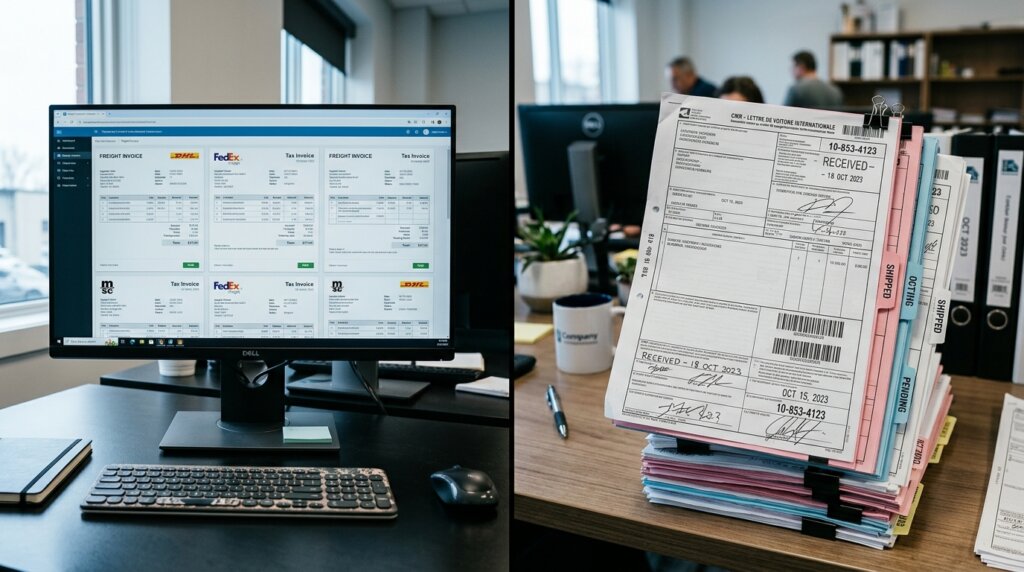
Invoice auditors are forced to toggle between multiple screens to reconcile data. An employee visually compares the line items in the Transport Management System (TMS) against the registered purchase order and the PDF document submitted in the accounting system. This lack of automated data flow causes hours of delays during every audit round. Without accurate data, the purchase invoice remains blocked, which in turn stalls the outgoing sales invoice to your own client.
Errors and unexplained discrepancies during this manual reconciliation generally fall into a few specific categories. The most common mismatches on freight documents include:
- Declared base rates differ from the originally agreed spot rate
- Applied fuel surcharges (BAF) are based on a different indexation month than agreed
- Claimed waiting times or loading/unloading hours lack formal authorization from the planner
- Fees for pallet exchange and packaging are billed without supporting evidence
- End-customer reference numbers are missing, causing margin calculations to fail
Complex Tariff Structures and Variable Surcharges
Even minor discrepancies within complex logistics contracts immediately halt automated processing loops. Carriers itemize invoices with dozens of variable surcharges, such as tolls (Maut), congestion fees, and seasonal levies. The moment an indexed fuel surcharge deviates by just a few cents from what the financial system expects, it triggers a hard accounting mismatch. The application then forces human intervention. Employees have to dig through original tiered contracts to validate whether the additional submitted surcharge was legitimate at the time of the transport. These micro-deviations require minutes of investigative work per file, causing folders full of unaudited freight invoices to pile up and never reach the billing stage.
The Choke Point of Paper Freight Documents (CMR)
Waiting for legally required physical transport documentation further stretches administrative lead times. Drivers generate original, pen-signed CMR waybills at delivery addresses. This document serves as the definitive Proof of Delivery (POD). Without this signature, the forwarder lacks certainty that the cargo was unloaded undamaged. To eliminate the risk of external disputes, accounts payable departments block outgoing payments until either the physical POD or a legible scan is available in the Document Management System (DMS). This unpredictable wait for paperwork from foreign hubs brings the entire chain of approvals and subsequent billing to a grinding halt.
The Chain Reaction: From Procurement Delays to Higher DSO
A five-day delay during the procurement audit translates directly into a delayed invoice to the client. For logistics service providers and forwarders who pass on variable transport costs with a markup, the purchase invoice is the direct starting gun for sales invoicing. A delay on the front end inevitably pushes the billing moment farther backward. It is worth noting that this one-to-one causal link does not apply to companies operating with fixed or flat-rate all-in transport prices; in those cases, the sales side runs independently without a financial cross-check per shipment.
The overviews Accounts Receivable Administration: An Important Instrument – Atradius, Improve Cash Flow and Collections Efficiency – Emagia, and informational material from What is Accounts Receivable? | SAP all highlight the associated credit risks. Days Sales Outstanding (DSO) rises proportionally with the backlog. Working capital remains trapped between unprocessed purchasing data and pending sales invoices. A disrupted cash flow ultimately erodes the liquidity needed to finance business growth or regular operational expenses.
Calculation Example: The Measurable Cost of a 5-Day Delay
Quantifying trapped capital requires looking at the relationship between revenue and time. Consider a mid-sized logistics player generating €1 million in monthly revenue from passed-on transport shipments. This represents precisely €33,333 in billing per calendar day.
When the reconciliation process structurally drags on for an extra five days due to manual rate checks and missing documentation, the value of unbilled services accumulates rapidly. The organization instantly locks up €166,666 of working capital in the back office (5 days x €33,333). The company continuously pays interest on this reserved amount through its own credit lines—or misses out on investment returns—even though the shipment itself was physically completed long ago.
Delayed Payments Due to Disrupted Budgeting Cycles
Invoices that arrive late often run into fixed payment cycles and budgeting rounds on the client side. Many well-organized buyers execute specific payment runs on set days of the month. If a suspended, late-consolidated invoice misses the weekly or monthly closing of the end-customer’s procurement administration, payment inevitably shifts to the next run. An initial five-day back-office delay at the forwarder’s end can effortlessly escalate into an extra thirty-day payment term due to the client’s rigid budgetary rules.
Internal Friction: Operations, Sales, and Finance Out of Balance
Invoice disputes cause organizational collateral damage far beyond the finance department. The article What is Accounts Receivable Administration? – Debitan points to the disruptions that arise when a financial file is not presented conclusively. Administrative staff block the open invoice because price differences with the carrier haven’t been formalized in the contract. To prevent margin loss due to incorrect invoice payments, stringent auditing is absolutely crucial at this stage.
This creates a massive “ping-pong effect.” Accounts payable administrators demand explanations for discrepant amounts from their own internal forwarders. The forwarders, in turn, seek clarification from the logistics manager of the hired transport company. Simultaneously, complaints reach sales managers, driven by panicked end-customers who cannot close their current cost budgets due to missing final project invoices. With fifty complex cases, where three different employees spend twenty minutes emailing back and forth per file, the organization loses over fifty productive work hours a week purely to internal escalations and meetings.
Silos Between Accounts Payable and the Warehouse Floor
The operational employee who quickly handles an emergency booking manually (Operations) follows a completely different workflow than the person who ultimately approves the entry (Finance). Without tightly organized data sharing, the company loses oversight. Crucial ad-hoc price agreements, passed along via a quick WhatsApp message or private email with the courier, never reach the accounts payable department. The auditor, looking at the ERP system from a purely procedural standpoint, detects a rate mismatch and slams the brakes on an already approved run until the communication silo is broken.
Client Dissatisfaction as a Direct Result of Incomplete Invoicing
Sluggish and reactive billing damages commercial relationships. Clients expect tight budget control on closed logistics assignments. Once goods are sold and the invoice is sent to their own customer, they expect everything to be finalized. Transport costs that unexpectedly surface six weeks later ruin completed cost calculations. Account managers bear the brunt of this frustration, repeatedly having to explain structurally late and poorly substantiated charges, which ultimately erodes your clients’ trust.
Why Treating Symptoms Increases the Error Margin
Quick, superficial fixes to disrupted reconciliation processes only mask the challenge temporarily. Publications such as Solving Transport Overbilling: Stop the Administrative Chaos and insights on capital management in What is Accounts Receivable? | SAP illustrate how hasty interventions only intensify the root problems. Companies often try to stop the mounting tide of paper using rigid technology or unqualified temporary manpower. Both routes pose significant obstacles to genuine, long-term process optimization.
The Shortcomings of Standard OCR Software
Standard Optical Character Recognition (OCR) software converts incoming documents into data but falls noticeably short when context is missing. Off-the-shelf packages natively extract text fields from a scanned waybill, but real-world freight documents contain handwritten notes, creased sections, faded ink stamps, and poorly printed reference codes. Lacking logical reasoning, OCR might accidentally read a cargo weight in kilos as a currency amount. Technology disconnected from an experienced human auditor silently creates highly specific manual correction errors in the final output.
The Risks of Temp Staff in Logistics Forwarding Systems
Hiring local, ad-hoc staff during seasonal peaks invariably leads to a drop in quality. Forwarding systems require navigating complex tariff agreements and refined Incoterms. A temporary worker faces an incredibly steep learning curve before they can operate the auditing system flawlessly. This operational reality brings substantial training costs for your experienced onboarding staff. Due to untrained hands, incorrect data entry easily slips into the systems, allowing unjustified surcharges to pass straight through to the accountant without verifiable protest.
Processing unstructured freight documentation, missing PODs, and manual reconciliations creates a stagnant financial cycle that bottlenecks both work hours and liquid assets. By focusing on scalability and structural data accuracy, companies can achieve controlled cost management without relying on local flex contracts. Professional logistics back-office outsourcing – DataMondial—leveraging EU-compliant nearshoring facilities in Romania—acts immediately as your reliable Dutch safety net for Business Process Outsourcing (BPO) and RPA-driven document processing. Alleviate the operational pressure and equip your organization with reliable capacity that secures smooth, risk-controlled data flows directly into your administrative systems.