Consolidating FCL and LCL Rates: A Framework for One Unified Master File
Introduction: The complexity of unstructured rate data
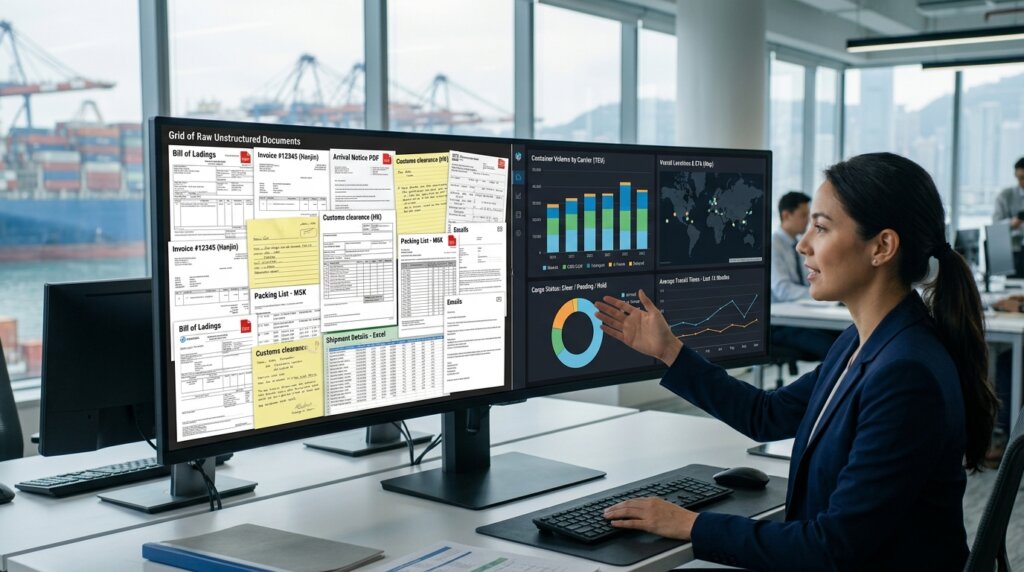
Margin loss in freight forwarding and logistics often begins long before the actual shipment—right at the interpretation of ocean carrier rates. Sea freight carriers typically distribute pricing agreements in a highly fragmented manner. The result is a continuous stream of PDF documents and complex, unregulated Excel sheets with varying structures. To guarantee operational efficiency, timely and accurate ocean freight rate processing is essential. Without data normalization, this fragmentation inevitably leads to billing errors and eroded profit margins.
The root of this data problem lies in the fundamental difference between pricing for Full Container Load (FCL) and Less than Container Load (LCL). While FCL calculates costs using fixed units per TEU or FEU, LCL forces forwarders to work with fluid Weight/Measure (W/M) ratios where volume and weight dictate the price. The margin of error when manually transferring these distinct accounting units immediately eats into operational costs.
Rates are subject to exchange rate fluctuations and volatile market dynamics. Allocating a specific data field for the ‘validity date’ in every incoming rate line is the only way to guarantee that quotes and final bookings match the actual purchase value. A missing or incorrectly logged validity date makes historical rate comparisons impossible and obscures financial risks from the controlling department’s view.
Phase 1: Deconstructing structural metrics
The successful setup of a uniform master file hinges on a strict separation between FCL and LCL base units at the database level. Systems must meticulously differentiate record types to prevent calculation errors in the final invoice.
FCL base rates require static, distinct record fields. For FCL, specific columns are designated for 20ft, 40ft, High Cube (HC), and Reefer containers. LCL demands a dynamic setup with a built-in calculation field for the ratio between CBM (cubic meters) and kilograms. Locking in the correct billing unit per booking line prevents dual interpretations on the operational floor. The market generally uses 20 CBM as the logical tipping point where a shipment transitions from LCL to FCL pricing for cost efficiency.
The table below illustrates the standard translation from W/M to standardized data fields, similar to the normalization processes seen on platforms like 1688 tracking – International parcel tracking for global consolidation:
| LCL Parameter | Standard Unit | W/M Conversion Rule | Master File Field Name |
|---|---|---|---|
| Volume | CBM (Cubic Meters) | 1 CBM | LCL_Vol_CBM |
| Weight | Kilogram / Ton | 1,000 kg (1 Metric Ton) | LCL_Weight_KG |
| Billing Base | Revenue Ton (RT) | Max(CBM, MT) | LCL_Billable_Unit |
Container types as the FCL foundation
For FCL, the standard dry-box serves as the base rate. Non-standard equipment types, such as open top containers or flat racks, demand direct processing into separate columns within the master file. A rate for a 40ft Reefer represents a completely different risk and cost profile than a standard 40ft container. By locking in these foundations as independent data points upfront—just as international carriers visibly do in architectures from 1688 tracking – International parcel tracking—cross-contamination of rates is avoided.
The LCL dynamic: Translating Weight/Measure (W/M)
Correctly translating the W/M dynamic requires a hard-coded formula in the data schema. The industry standard dictates that 1 CBM equals 1,000 kilograms. As soon as a shipment’s weight per CBM exceeds this threshold, the forwarder bases the rate on weight rather than volume. In an optimized system, hitting the 20 CBM mark automatically triggers an alert for FCL conversion. Standardized conversion, comparable to the standards in reference models like 1688 tracking – International parcel tracking, prevents margin leakage on heavy cargo shipments.

Phase 2: Normalizing surcharges and local fees
Variable costs and surcharges dictate the net result of any transport file. These costs necessitate a logical, centralized framework that enables direct comparisons across different logistics providers.
Surcharges such as the Bunker Adjustment Factor (BAF), Currency Adjustment Factor (CAF), and Terminal Handling Charges (THC) require specific processing logic. With FCL shipments, these surcharges are calculated per shipped unit. Within LCL files, a pro-rata allocation applies: the fee is passed onto the specific volume or weight of the partial shipment in question. The primary objective when configuring the master file is stripping away carrier-specific terminology. Group surcharges under generic, fixed headings to enforce mathematical uniformity. Please note: this specific framework covers regular LCL and FCL cargo. Project cargo or breakbulk involves calculation methodologies that fluctuate so heavily that standardization via this logic cannot scale effectively.
Building apples-to-apples comparisons
Carrier A labels a fuel surcharge as ‘EBS’ (Emergency Bunker Surcharge); Carrier B uses ‘BAF’. Without intervention, the system becomes cluttered with duplicate entities for the exact same expense. Applying rigid naming conventions resolves this easily. Link the incoming jargon to a fixed anchor value, such as Surcharge_Fuel or Surcharge_Currency, similar to data registries used for complex routes at 1688 tracking – International parcel tracking. This enables forwarders to place the actual cost price per route directly side-by-side.
Strict separation: Port-related charges vs. ocean freight
Separating ocean freight from local port costs (origin and destination charges) safeguards the reliability of the relational database. Ocean freight rates change with high frequency, often weekly or monthly. Port fees and terminal surcharges, however, generally carry an annual or semi-annual validity period. Storing these costs in separate, independent entities prevents consecutive ocean rate updates from accidentally over-writing a still-valid THC. This stratification beautifully mirrors the structure applied in global tracking systems like 1688 tracking – International parcel tracking.
Phase 3: Automated extraction and mapping
Manual entry of rate data heavily drives up logged hours and operational failure costs. The solution lies in the targeted integration of technology, coupled with end-validation by specialized logistics personnel.
Deploying Robotic Process Automation (RPA) handles the bulk processing side. RPA scripts scan for fixed anchors in documents, extract the values, and write them directly into structured fields. To configure this process without data loss, a strict sequence is followed to ensure ocean freight rate processing runs flawlessly.
- Ingestion: The RPA script scans the inbound inbox and identifies static PDFs and Excel attachments.
- Extraction: Table recognition technology records row and column positions to effectively extract figures, conditions, and validity dates.
- Transformation: The software maps the carrier’s proprietary terms back to the established internal conventions (e.g., CBM to
LCL_Vol_CBM). - Staging: The data is temporarily parked in a secure, isolated buffer environment.
- Validation: Operational logistics operators run rule checks on discrepancies and structural errors within the staging environment.
- Commit: Approved rates are pushed through to the live FMS (Freight Management System) for immediate activation.
Automation falters when unexpected changes occur in a form’s layout. To guarantee back-office business continuity, this framework relies heavily on human monitoring. BPO (Business Process Outsourcing) utilizing EU-based professionals provides the automation with an indispensable safety net, thoroughly aligned with data protection guidelines and the workflow methodologies discussed in LCL & FCL File Management
Deploying RPA for static formats
RPA fetches data based on strict coordinates. Where a freight forwarder naturally reads a PDF, the bot ‘sees’ rigid cell positions. This technology slices up unstructured sheets. By training the bot on specific cell structures, the script can swiftly identify whether an amount belongs in a 40ft record field or is intrinsically linked to the weight/measure dynamic for LCL shipments, as prescribed within modern LCL & FCL File Management
The necessity of a staging environment
The staging environment functions as a highly effective quarantine filter. Extracted partial shipment data is instantly matched against master container registrations here before overriding the database. This inherently stops corrupted rate data from infecting active bookings. During consolidated shipments, the systems verify directly in this phase whether the combined LCL data falls accurately under the correct master Bill of Lading—an absolute cornerstone for error-free handling as detailed in LCL & FCL File Management

Conclusion: Securing accuracy via hybrid data processing
Consolidating rates immediately reduces operational error margins and effectively scales operational capacity by separating and standardizing billing units and surcharges across the board. The framework demands a thoroughly designed data table setup paired with clear, hard-coded conversion rules around W/M ratios. This only truly succeeds when you actively back your automated tooling—via RPA extraction and staging—with expert human oversight. Are you looking for a secure, scalable way to establish your data management and optimize your ocean freight rate processing? Discover how DataMondial leverages EU-compliant nearshoring to streamline your logistics data processing, ensuring your FMS is continuously fueled by exceptionally reliable rate information.