Title: Streamlining Container Documentation: Hybrid vs. Fully Manual Processing Primary keyword: container documentation processing

The Hard Limits of Fully Manual Processing

Logistics operations inevitably hit the hard limits of manual data entry during peak seasons. As global freight volumes double, the influx of waybills, customs declarations, and Bill of Lading (B/L) documents creates severe backlogs. Professional [logistics back-office outsourcing – DataMondial](/en/diensten/remote-backoffice-voor-logistiek) offers a critical solution here, as human processing capacity simply cannot scale proportionally with these massive volumes. Recruiting additional staff or hiring temps requires weeks of onboarding and training. Furthermore, persistent labor shortages in major logistics hubs directly translate into premium hourly rates, driving up your Cost Per Document exponentially.

The physical and cognitive toll of highly repetitive work also creates dangerous operational blind spots. Manually typing complex, alphanumeric strings for hours—such as reference numbers, container IDs (e.g., MSKU1234567), gross weights, and specific Harmonized System (HS) codes—causes inevitable fatigue. This fatigue is the primary driver of data entry errors. The report RPA Logistics Back Office: Why Bots Fail at Customs documents exactly how a single typo in a customs tariff code can result in containers being detained at port terminals.

Such bottlenecks in the customs release process generate mounting daily demurrage and detention charges. Crucial subsequent milestones, including scheduled hinterland transport via rail or road, grind to a halt because the cargo lacks administrative clearance. Suddenly, relying on manual data entry for hundreds of daily documents shifts from a standard operational routine to an active threat to supply chain continuity. Depending entirely on human input actively chokes your cargo turnaround times.

The Mechanics of Hybrid Data Processing

Hybrid data processing resolves both volume and quality bottlenecks by uniting Optical Character Recognition (OCR) and Robotic Process Automation (RPA) with targeted human validation. Incoming document streams are first routed to a software bot. OCR technology digitizes freight templates, scanned images, and PDFs. Trained RPA algorithms then categorize the files by document type and map the designated data fields. The software rapidly extracts critical values—such as shipper details, package counts, and ports of loading—formatting them for direct import into an underlying TMS, FMS, or WMS.

Automation easily absorbs the heavy, repetitive volume. As detailed in the industry analysis Data Processing – EasyData, the software calculates a confidence score for every single field it reads. Consequently, exceptionally complex or highly irregular document layouts don’t crash the system; instead, they trigger a human safety net. The bot processes the clean, structured data, while a back-office specialist steps in to evaluate only the illegible or uncertain fragments. This guarantees that your workflow doesn’t jam up at minor form variations.

For logistics service providers maintaining strict EU-compliance standards, this human-in-the-loop validation is effectively managed via structured [nearshoring](/en/denkt-jouw-bedrijf-aan-nearshoring-neem-een-kijkje-in-de-keuken-bij-ons-remote-team-in-roemenie). A Business Process Outsourcing (BPO) operation in Eastern Europe, such as Romania, delivers the required scalable capacity. Operating under Dutch management and adhering strictly to GDPR frameworks ensures short communication lines and uncompromised data security. Moreover, because the operation functions in the same time zone, logistics teams can respond immediately to urgent freight issues.

Routing Exceptions via Confidence Scores

The operational division between routine bot work and complex human intervention hinges on a predefined threshold, typically set at 95% certainty. During extraction, the OCR application generates a percentage indicating its confidence in the recognized text. If the field meets or exceeds the 95% threshold, the script exports the data directly to the customs system, completely bypassing human intervention. Standardized freight documentation containing digital barcodes from regular partners routinely hits this threshold.

However, if the score drops below this benchmark—perhaps due to a faded stamp, a fold in the scanned paper, or an unfamiliar packing list layout—the system triggers an immediate alert. The specific data row pops up on a BPO operator’s monitor, using a split-screen interface that displays the original file alongside the bot’s proposed text. The specialist manually verifies the value and corrects the discrepancy. Insights from RPA Logistics Back Office: Why Bots Fail at Customs and documentation from Data Processing – EasyData confirm that this 95% filter actively prevents bots from pushing flawed data to customs authorities. This rigorous validation guarantees absolute Data Accuracy prior to official submission, eliminating the risk of customs fines for incorrect classifications.
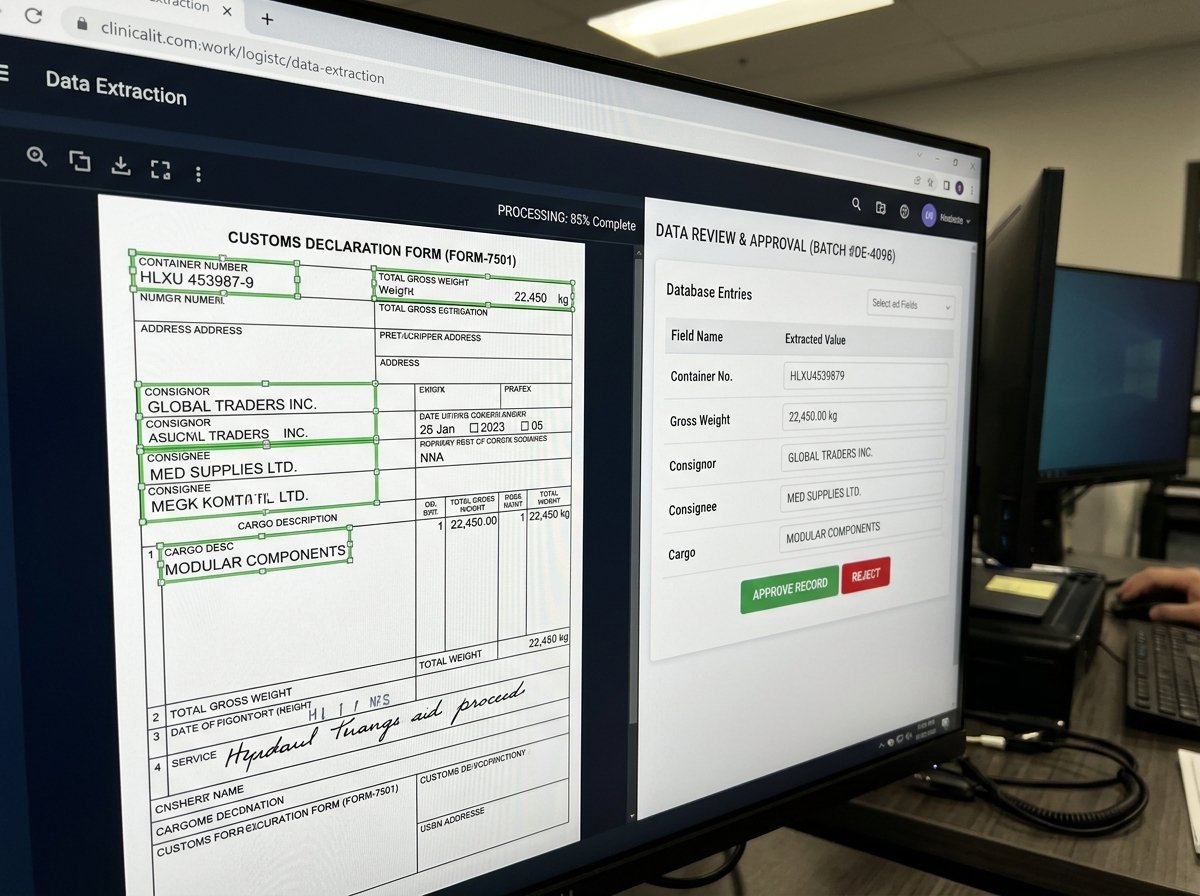
Container documentation processing software extracting data from customs forms heavily into a centralized database.

A Strategic Comparison: Speed, Quality, and Scalability

Selecting your operational model requires a calculated assessment of processing limits and resource allocation. Drawing from market intelligence, including Data Processing – EasyData, the following table contrasts the two fundamental approaches to managing freight documentation.

ComponentFully Manual ProcessingHybrid Processing (RPA + BPO)
ScalabilityCapacity stagnates at the limits of available FTEs. Sudden volume spikes immediately generate backlogs in the manifesting process.Expanded server capacity absorbs document-level volume spikes instantly. Staff only intervenes for specific data-line exceptions.
QualityError rates surge alongside human fatigue (“fat-finger errors”) during the manual transcription of customs tariff codes.RPA eliminates typos entirely on high-confidence fields. The specialized BPO team applies deep operational logic to resolve the rest.
CostsPayroll maintains a linear relationship with freight volume. Cost Per Document remains rigidly constant or exceeds budgets during temporary hires.Limited to a one-time setup cost for template architecture. Produces a structural decline in Cost Per Document as extraction volumes climb.

Guided by these variables, operations managers can make pragmatic decisions based on their specific annual volumes. The following decision tree serves as a practical baseline:

  1. Volume under 10,000 documents per year, highly variable formatting The manual model remains cost-effective here. The processing frequency is simply too low to ever realize an ROI on OCR licenses and bespoke RPA bot development.
  2. Volume between 10,000 and 50,000 documents per year Implementing a “light” hybrid setup—focusing exclusively on automating your top 5 most frequently recurring document layouts—yields immediate savings in labor hours and noticeably reduces error margins. The remaining unstructured workflow is still managed via outsourced manual processing.
  3. Volume exceeding 50,000 documents per year At this scale, a strictly hybrid framework becomes an operational necessity. Automated extraction easily shoulders the massive baseload. Paired with a BPO team thoroughly trained in freight forwarding compliance, this setup creates the ultimate defense against peak season surges and brutal ocean freight cut-off times.

Specialist correcting container documentation processing using a pen and software interface at a modern office desk.

Exceptions: When the Hybrid Approach Falls Short

Technological process optimization has defined boundaries. It’s important to acknowledge that not every facet of document processing benefits from advanced systematic setups. For certain freight forwarders and road transport carriers, the hybrid model simply fails the financial and practical stress test. Logistics providers operating within specialized regional networks, or handling heavy exception-based transport, often process extremely low volumes of documents that suffer from wild, unpredictable layout variations.

A hard systemic refusal occurs when manifests are completely analog. Handwritten CMR waybills, weights scribbled in pencil on loose slips, or cargo documents heavily obscured by stamps and aggressive ink signatures easily defeat standard OCR engines. Building an AI infrastructure solely to translate this chaotic, unstructured data into WMS-ready formats requires disproportionate and expensive training time. Back-office bots fundamentally lack the human ability to deduce context from a badly crumpled waybill without explicitly pre-programmed rules—a reality confirmed by case studies in RPA Logistics Back Office: Why Bots Fail at Customs.

For these documented edge-cases, machine-reading essentially guarantees system rejections and frustrating recovery loops. For this specific fraction of the market, pure, 100% human interpretation by an industry specialist remains the only reliable method for landing complete, accurate freight data into your target system.

Ultimately, transitioning to a filtered, hybrid dataflow empowers 3PLs and freight forwarders to slash processing times and intercept supply chain disruptions before they cascade. When massive volume processing is anchored by software—and critically supported by nearshore QA specialists operating strictly within EU legal frameworks—you achieve the perfect balance of data security and business continuity. Discover how exactly DataMondial analyzes, optimizes, and manages your logistics data entry through a highly reliable [logistics back-office outsourcing – DataMondial](/en/diensten/remote-backoffice-voor-logistiek) partnership, uniquely tailored to your organization’s volume constraints.

Title: Freight Invoice Auditing: In-House Capacity vs. Nearshore Expertise Primary keyword: freight invoice auditing

Introduction: The complexity of manual freight invoicing

A transport operation is only truly successful when the financial settlement is fully resolved. In daily operations, planners frequently deal with freight invoices that deviate from the original purchase order. Unforeseen costs—such as waiting hours, a fluctuating Bunker Adjustment Factor (BAF), or revised toll charges—turn the auditing process into a time-consuming burden. Manually ticking off every invoice line distracts logistics personnel from their core responsibilities: capacity planning and relationship management.

Logistics providers face an operational dilemma. On one hand, flawlessly reconciling purchase and sales invoices demands strict control. On the other hand, recruiting specialized administrative staff locally is an expensive and arduous task. Shifting this invoice flow through [logistics back-office outsourcing](https://datamondial.com/en/diensten/remote-backoffice-voor-logistiek) to a specialized European back office provides a structural solution to data processing bottlenecks and margin erosion.

The hidden costs of in-house freight invoice auditing

Handling repetitive data management locally creates a skewed ratio between payroll costs and actual added value. Highly qualified freight forwarders spend hours chasing down invoice discrepancies. This internal process carries a direct operational risk: employee absenteeism or turnover immediately brings financial processing to a halt. Recruitment costs weigh heavily on the budget, while onboarding new staff slows down overall turnaround times.

Volume peaks expose the vulnerability of an in-house model. As soon as shipment numbers rise, operational friction increases in the office. This results in expensive overtime or being forced to skip crucial detailed checks. According to Sendcloud’s Invoice Check, twenty percent of transport invoices contain errors. When time pressure causes a forwarder to overlook thirty minutes of unjustified passed-on waiting hours (at €45 per hour), margins structurally leak away. With an influx of five hundred invoices a month, this lost profit quickly amounts to thousands of euros.

Impact of error margins and exceptions

The findings from the Sendcloud data demand action: one in five invoices requires immediate correction. Freight invoices are notorious for their complex surcharge structures. Demurrage and detention claims, currency fluctuations, and fuel surcharges frequently deviate from established framework contracts. Blindly accepting a discrepancy can reduce the gross margin of a trip below the break-even point. This calculation demonstrates that manual auditing under pressure leads to blind spots, resulting in direct, measurable financial loss.

Capacity challenges and fixed overhead

Logistics flows fluctuate by season. Synchronizing permanent staff with these swings creates friction. Scaling up fixed FTEs to absorb peaks places a heavy burden on overhead during quiet periods. Conversely, understaffing guarantees unchecked invoices and cash flow issues when volumes surge. The operational objective is to correctly and promptly reconcile the administration—without permanently increasing the payroll.

Automated dashboard for freight invoice auditing with 3-way matching and an RPA workflow in a modern office.

Nearshoring within the EU: Scalability without compliance risks

Structuring a logistics back office in Romania solves the capacity problem while maintaining exceptional data quality. This nearshoring model operates within the same European work culture and shares nearly the exact same time zone as the Netherlands. This entirely prevents the communication delays commonly associated with offshore models in Asia.

Operations rely on a hybrid structure: advanced technology processes the bulk, while human experts manage the exceptions. Robotic Process Automation (RPA) extracts data from incoming documents and automates repetitive entry. Highly trained Romanian data experts, operating under the guidance of Dutch management, immediately take the wheel as soon as the system flags a discrepancy.

Hybrid processing: RPA combined with domain expertise

Technology filters the workflow through strict ‘3-way matching’. The system cross-references the purchase order, the signed waybill (CMR), and the incoming freight invoice. If there is an exact match, the invoice is automatically approved. Human domain expertise steps in for the deviations. An unexplained damage claim or a fuel surcharge deviating from the indexation halts the automated process. The human expert analyzes the discrepancy and arranges the correction with the carrier or consults directly with your core planners.

Data security strictly tied to European regulations

B2B data transfers in logistics contain sensitive contractual agreements, freight rates, and customer data. Keeping this data within the borders of the European Union provides legal peace of mind. Nearshoring in Romania means all processing strictly complies with the General Data Protection Regulation (GDPR). The complex contractual setups required to safely park data outside the EU—as is necessary with offshore destinations—are obsolete. Corporate data remains completely protected by standard European privacy frameworks.

Decision matrix: When to keep it in-house or outsource out?

Outsourcing is a strategic choice driven by numerical facts. Business Process Outsourcing (BPO) delivers a strong ROI when dealing with high volumes, fluctuating invoice formats, and predictable capacity bottlenecks. There is a transparent threshold: nearshoring offers little added value for companies processing fewer than thirty highly standardized invoices a week. Below that volume, the setup and implementation costs simply don’t outweigh the hours saved.

Criteria for internal processing

Local processing remains the logical route for very low invoice volumes coupled with a zero-tolerance policy for process change. If invoices consist of just a few lines without variable surcharges, and current administration handles them within regular hours without disrupting core capabilities, outsourcing yields no immediate operational advantage.

Evaluation framework: In-house versus Nearshore

Offsetting fixed personnel costs against variable processing costs highlights the deep financial and operational differences. The table below provides a comparison between both models based on cost structure, control mechanisms, flexibility, and compliance.

CriterionIn-house processingNearshore BPO (EU)
Cost per invoiceHigh (tied to fixed FTE salaries)Low (variable or output-based)
Quality controlSusceptible to time pressure and human errorStandardized via a hybrid RPA model
Scalability during peaksLow (risk of backlogs or expensive overtime)High (flexible deployment of trained teams)
Data security complianceManaged locally according to company policyFully GDPR-compliant within the EU framework

Choose a scalable structure

Strict 3-way matching and robust freight invoice auditing protect your transport margins from escalating surcharges and revenue leakage. By shifting this invoice control to a nearshoring partner, you significantly relieve recruitment pressure and transform fixed labor costs into a highly scalable invoicing capability. Discover how to increase data accuracy and systematically offload your internal planners by efficiently setting up your [logistics back-office outsourcing with DataMondial](https://datamondial.com/en/diensten/remote-backoffice-voor-logistiek).

We assist a large number of software, AI and scanning companies specializing in OCR and AI with data validation, data processing and machine learning where it is not yet technically possible to fully automate the processing of the data (whether textual or visual). Recognition of complex or unstructured documents (such as invoices and orders) and images in particular can be challenging. For our clients, we therefore complement their digitalization.

Validating, checking and training the computer

Our remote team can be used for time-consuming and repetitive basic data tasks such as validation and checking of complex invoices, PDFs, orders, damage claim forms, etc. We can also check whether automatically read data (for e.g. invoices) has been converted correctly: amounts, reference numbers, invoice numbers, IBAN data, products, quantities, prices, etc. We will rapidly and correctly input all data that was incorrect or that had not been included.

Labelling objects in documents and images to allow recognition in an OCR or AI system is another task you can leave to us.

Safe and trusted

All data processing is (of course) done confidentially and in line with the GDPR. We train our team according to work instructions that are drawn up jointly with the client. Our activities are defined in SLAs that are strictly observed and that work is then carried out with the utmost care.

Using our services lets our customers save time and money, and they can then use their own people for other core tasks.

Do you also need help for data validation, data processing and annotation?

If you’d like to know what we could do for your company, please contact us to make an appointment. Take a look at our data validation page for OCR, AI and machine learning for more information too.

Our client, a leader in service management solutions, approached us for a challenging project. They were faced with the task of transferring their blog archive of over 1,000 entries from their old content management system (HubSpot) to a new system (WordPress). That step was needed for optimizing the user experience for their customers. The information on their website had to be made easier to find.

Our approach to a data migration project

Migrating a considerable amount of content in multiple languages plus images, all without data loss, was a complex task. Together with our client, we developed a streamlined process that made sure the transition went smoothly and that the content could be integrated flawlessly into WordPress.

The work was done using detailed work instructions that described every step of the activities to be carried out. All content was placed in the correct ‘fields’ (title, text, image, etc.) of the content management system, and then categorized and tagged correctly so that the blogs could be searched for.

As a final step, our remote team carried out a quality check to make sure that our work fulfilled the expectations.

DataMondial’s professional remote team completed this large-scale job carefully, quickly and efficiently. The number of visitors to our website has gone up considerably.

Do you also need help with a data transfer project?

If you’d like to know what we could do for your company, please contact us to make an appointment. Take a look at our data management and optimization page for more information too.

Our client is a market leader in digitalization and data processing for insurers (including health insurance companies) and implementing bodies in the Netherlands. They largely take over the administrative processes for their own customers. We are their preferred partner for processing and checking data in insurance dossiers and insurance declarations, where these cannot be processed through OCR or robotization.

In this client’s application, we are the fallback solution when data in the application has not been correctly processed; we also do the checks on the automated systems.

Our approach

A human touch is almost always needed when administrative processes are being digitalized. We have been assisting this client for several years in complex data processing and data validation issues. The documents are processed and validated with the highest level of accuracy to ensure that all the information is correct and
compliant with the requirements.

Specialist departments

Our departments are strictly organized for the tasks and the clients. This means that our people are fully up to speed with all the ins and outs of the specific tasks we carry out for them. All the activities are defined in precise work instructions and we then do the work according to strict SLAs.

Our processes are designed to minimize the processing time while at the same time maximizing accuracy. This yields significant savings for our client in terms of time and costs.

DataMondial is a preferred partner whose specialist services for data processing and data validation let them play a role in improving accuracy and efficiency while creating time and cost savings. There are good reasons why they’ve been our partner for so long.

Do you also need help for data processing and data validation?

If you’d like to know what we could do for your company, please contact us to make an appointment. Take a look at our data processing page for more information too.

We support organizations with content management, product data optimization, data processing, web research, and the management of large product catalogs. This enables companies to maintain consistent product information, improve search visibility, and enhance the overall e-commerce experience.

A leading lighting wholesaler in Belgium wanted to improve its digital product experience and future-proof its e-commerce platform.

With more than 10,000 products, the organization managed a large volume of data that was fragmented, inconsistent, and partly outdated. This resulted in an unclear product structure and a suboptimal user experience, directly impacting online conversion rates.

Content Management and Product Data Optimization Project

To optimize and standardize an online product database containing more than 10,000 products, our remote team successfully completed this project.

The Challenge

The client faced a classic e-commerce challenge: a large product catalog without a unified data structure. Product information was spread across multiple sources and was often inconsistent or outdated.

This resulted in a fragmented product experience, making it difficult for customers to quickly and accurately find the right product information.

The goal was clear: to create a centralized, reliable, and scalable product database that would improve the digital product experience and support higher conversion rates.

Our Approach

We applied a comprehensive end-to-end content and product data optimization process across the entire product catalog.

In the first phase, we collected product data from internal systems, supplier sources, and external datasets. The data was then cleaned and validated through our Data Processing and Data Validation services, removing duplicate, incomplete, and inconsistent records.

Next, all product information was standardized into a unified data model, similar to our Data Migration and Data Management services, creating a stable and scalable foundation.

The structured data was then carefully integrated into the client’s CMS or PIM system. Where necessary, product information was enriched with additional attributes such as technical specifications, material details, and category metadata. This increased both the completeness and commercial value of the product data.

In the final phase, all information was thoroughly reviewed for accuracy, consistency, and completeness before being approved and integrated into the live environment.

The Result

The entire product catalog was transformed into a consistent, scalable, and user-friendly product database.

The e-commerce platform now benefits from a unified data structure with reliable product information. This has resulted in a significantly improved user experience, clearer product navigation, and better product presentation. Customers can find the right products more quickly, contributing directly to higher conversion rates.

In addition, product data management has become significantly more efficient and cost-effective compared with managing the process manually in-house. Thanks to the standardized structure and streamlined workflows, updates and decisions can be implemented faster and more consistently, improving overall operational efficiency.

“Through our partnership with DataMondial, we now have consistent product data, a better online customer experience, and improved conversion rates. This enables customers to find the right products faster while allowing us to manage our product information far more efficiently.” Wholesale Manager.

Experience Across Industries

We have successfully delivered similar content and data optimization projects for clients across a range of industries, including lighting, fashion, interior design, and bathroom products.

This experience enables us to understand how different industries structure their product data and allows us to adapt our approach to the complexity, scale, and systems of each organization.

Our Expertise

Our focus is on processing and optimizing product data as a foundation for better digital experiences and improved search visibility.

We structure and optimize large product catalogs, enrich product information, and ensure consistency and discoverability across CMS environments.

In addition, we transform product data into SEO-optimized content and provide translation and localization services. We also perform Web Research and Content Management to further enrich and complete product information.

In practice, we work extensively with structured datasets such as Excel and CSV files, which we process and integrate into CMS systems and e-commerce platforms. Where possible, we also implement optimizations directly within the e-commerce platform, ensuring product data is available quickly and efficiently.

Need Help with Content Management, Product Data Optimization or Web Research?

Datamondial helps organizations with content management, product data optimization, data processing, web research, and the management of large product catalogs.

Contact us to discuss your project and learn how we can help improve your product data quality, streamline content management, and enhance your digital customer experience

Our customer is a leading logistics service provider offering global transport and logistics solutions for companies. We have been assisting them for years in various logistical data processing activities. Because they were coming up against challenges in their data management, we are helping them improve and optimize their ERP system.

Our approach to a data management project

The customer works with an advanced ERP system for managing their logistical activities but they did not have enough accurate data and that was impacting their operational efficiency. Because of a lack of time and staff shortages, they decided to use our remote team for the update to their ERP system.

One of the tasks was checking and updating all the proofs of inspection for their logistics fleet. In addition, we carried out checks of the road licence paperwork for both the trucks and the trailers. All these activities were carried out according to work instructions that we drew up together.

DataMondial’s remote team made sure that the data consistency improved several notches.

Do you need help with data management and data optimization too?

If you’d like to know what we could do for your company, please contact us to make an appointment. Take a look at our data management and optimization page for more information too.

DataMondial is working with a rapidly growing European AI company. The client develops and implements self-learning systems in various sectors that help companies operate more efficiently. For one of their projects in the agricultural sector, in which developing an image recognition system is key, we have helped with the image labelling.

Our approach to AI projects

To ‘teach’ a potato sorting machine what is a potato and what isn’t, our remote team annotated thousands of photos of potatoes using four specific tags: potato, leaves, stones and the machine’s conveyor.

Together with our client, precise specifications and guidelines were drawn up for labelling the photos. These stated which tags are to be used and what criteria need to be adopted to guarantee consistent, high-quality labelling. The labelling itself used an advanced tool called Label Studio plus our client’s own techniques to apply accurate labelling to the correct objects in the images.

Our remote team follow the guidelines carefully and apply strict quality checks to ensure that the labelled photographs meet the client’s expectations.

Because human eyes and hands are still always needed for providing relevant training data for the computer systems and assessing whether the output is correct, we started working with DataMondial. Manually labelling photos is a time-consuming and expensive task for our internal team, so the choice to bring in an experienced remote team was an easy one.

Do you also need help with an AI project?

If you’d like to know what we could do for your company, please contact us to make an appointment. Take a look at our page about data validation for OCR, AI and machine learning for more information too.

One of the largest eSolutions providers in Germany in the field of vehicle claims management also deploys DataMondial as an addition to its state-of-the-art claims handling software. The data entry that cannot be automated/roboticised is processed by us. We offer our client a very fast delivery of all claims uploaded into the system within the allotted time frame, ensuring that the client achieves the KPIs and satisfaction that its end customers expect.

Our approach

Based on a complex work instruction, DataMondial processes the claims in a secure online platform. The turnaround time for the different types of documents is 1 to 2 hours. There are peak times when many claims come in almost simultaneously. For this, the dedicated team is scaled up to ensure that everything is processed on time within the clear Service Level Agreements. Rigorous quality reporting is part of the process.

More Information

Interested about the possibilities for your company? Check out our services or contact us.

Reliable logistics administration, data processing and operational support

DataMondial supports logistics organizations with logistics back office outsourcing, transport administration, data processing and complex administrative processes.

By combining specialized employees with Artificial Intelligence (AI), Robotic Process Automation (RPA) and smart process optimization, we help logistics companies process large administrative volumes efficiently, accurately and at scale.

For an international logistics service provider operating across multiple European seaports, DataMondial provides essential support within the logistics back office. This enables the organization to focus fully on its core activities within transport and supply chain management.

Logistics back office outsourcing project

The customer processes large volumes of logistics files, transport orders and administrative data every day.

Due to increasing volumes, growing complexity within logistics processes and the shortage of qualified logistics personnel, the organization needed a reliable partner capable of providing structural support.

The objective was clear:

To create a scalable logistics back office solution that could flexibly adapt to changing volumes while maintaining quality, speed and continuity.

The challenge

Within international logistics, administrative processes must operate continuously and without errors.

This includes:

  • shipping instructions;
  • import orders;
  • transport documentation;
  • invoice checks;
  • Track & Trace processes;
  • administrative follow-up of logistics files.

Due to high volumes and peak periods, the organization faced several challenges:

  • limited availability of specialized logistics personnel;
  • high administrative workload;
  • dependency on internal employees;
  • need for additional capacity during busy periods;
  • requirement for consistent quality and predictable processing times.

The organization was therefore looking for a partner who could professionally support logistics administration processes and provide scalable operational capacity.

Our approach

DataMondial a creat o echipă dedicată de backoffice logistic, adaptată complet la procesele, sistemele și cerințele de calitate aDataMondial established a dedicated logistics back office team that fully aligns with the customer’s processes, systems and quality requirements.

A dedicated supervisor monitors the quality, continuity and progress of the activities on a daily basis.

From our European nearshoring facility, we process large volumes of logistics information and support the customer with:

  • processing shipping instructions;
  • processing import orders;
  • transport invoice verification;
  • Track & Trace checks;
  • train bookings;
  • container repair approvals;
  • administrative support within logistics processes.

For this customer, we handle among other activities:

  • more than 26,000 shipping instructions;
  • 9,000 import orders;
  • more than 20,000 Track & Trace checks;
  • 150,000 transport invoice checks;
  • 5,000 train bookings;
  • more than 80,000 container repair approvals.

Through clear work instructions, quality controls and standardized processes, quality remains guaranteed, even when processing large volumes.

The result

Through logistics back office outsourcing with DataMondial, the customer has a stable and scalable solution for administrative process support.

The benefits include:

  • continuous support of logistics processes;
  • reduced dependency on internal capacity;
  • processing of large administrative volumes;
  • improved predictability of processing times;
  • reduced operational pressure on internal teams;
  • flexible scaling during peak periods.

As a result, the customer can focus on operational logistics, customer relationships and strategic improvements, while DataMondial ensures a reliable logistics back office.

“DataMondial provides structural support for our logistics back office. With a dedicated team, we can reliably process large volumes of administrative tasks, even when volumes increase. This helps us keep our processes stable while allowing our internal employees to focus on the activities that add the most value to our organization.” — Operations Manager, International Logistics Service Provider

Experience in logistics administrative support

DataMondial supports logistics organizations with various administrative processes where speed, accuracy and continuity are essential.

Our expertise includes:

  • logistics back office outsourcing;
  • transport administration;
  • logistics document processing;
  • data entry;
  • data processing;
  • invoice verification;
  • administrative process support.

Through our experience within supply chain processes, we understand the challenges logistics organizations face every day.n procesele de supply chain, înțelegem provocările cu care organizațiile logistice se confruntă zilnic.

Our expertise

DataMondial combines human expertise with technology and process optimization.

We support organizations with:

  • back office outsourcing;
  • data processing;
  • data validation;
  • document processing;
  • administrative support.

In addition, we use AI and Robotic Process Automation (RPA) to further automate processes, while our Human-in-the-Loop approach ensures reliable quality control for complex exceptions.

As a Dutch company, we deliver our services from our European nearshoring facility in Romania. This ensures that processes and data remain within the European Union while meeting high standards for privacy, information security and process quality.

Need support with logistics back office outsourcing?

Would you like to outsource your logistics administration, reduce operational pressure and improve continuity within your supply chain processes?

DataMondial supports logistics service providers with scalable solutions for logistics back office outsourcing, document processing and data processing.

Interested about the possibilities for your company? Check out our services or contact us.