The 24-Hour Delay: Why Asynchronous Back-Office Communication Is Putting Your European Delivery Times at Risk
What Asynchronous Communication Means for Cross-Border Transport
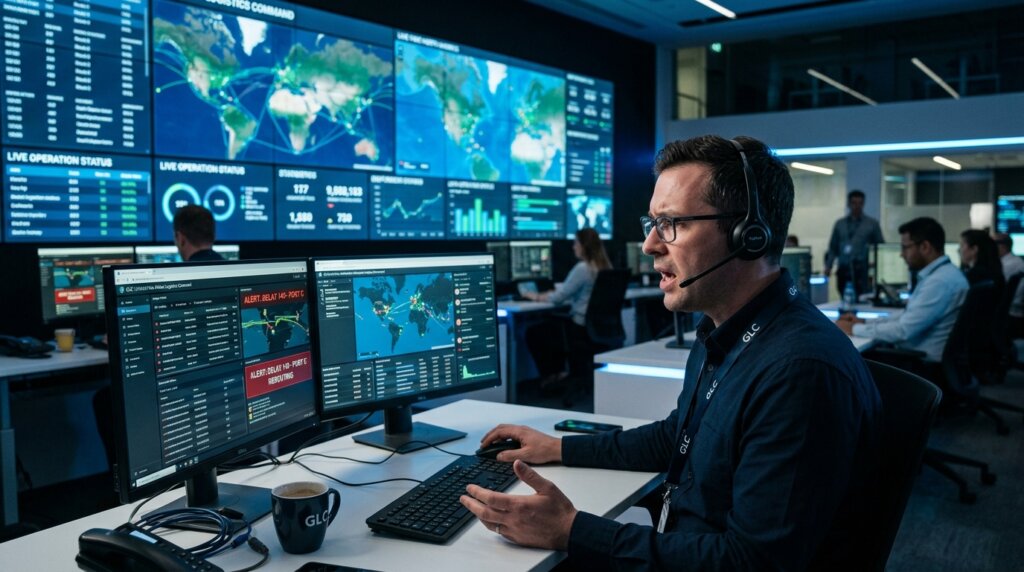
A truck-trailer combination comes to a standstill at 06:30 at a border crossing or ferry terminal. The cause: a typo or missing field in the MRN number on the accompanying export document. The driver loses driving time. The transport planner identifies the problem locally and logs a ticket with the offshore back-office team responsible for document processing. Many companies in situations like these consider professional back-office outsourcing to relieve the administrative burden on their core teams.
Because these back-office locations are typically based in regions such as the Philippines, India, or Vietnam, the planner immediately runs into the operational reality of border controls versus overseas office hours. In the Philippines (UTC+8), the regular working day is already winding down. In India (UTC+5:30), a reduced crew is on standby awaiting the shift changeover. A document correction that needs to be resolved within 30 to 60 minutes to keep the day’s distribution schedules intact is pushed to the next business day at the offshore location. The wait time for the locally stranded truck balloons from a tight hour to an 8-to-12-hour blockade.
Asynchronous communication arises simply because sender and receiver operate outside each other’s regular time windows. It forces logistics data submissions and corrections into a delayed turn-based system. Standard ticketing systems fail in this dynamic — they process incoming requests on a first-in, first-out basis distributed across multiple operational sites or time zones. The absence of overarching, real-time oversight means incidents sit idle in a queue instead of being addressed immediately.
Time Zone Overlap Is What Matters — Not the Hourly Rate
The operational scalability of business process outsourcing (BPO) is often calculated primarily on the local hourly rate, yet in practice it is the time zone overlap that dictates turnaround time. The table below provides a clear framework of synchronized working hours per country relative to standard European time.
| Region / Country | Time Zone (vs CET) | Overlapping Office Hours (08:00–17:00 CET) | Back-Office Response Model |
|---|---|---|---|
| Romania (Nearshoring) | CET +1 | 8 hours (full working day) | Synchronous |
| India (BPO) | CET +4:30 / 3:30 | 3.5 to 4.5 hours | Partially asynchronous |
| Philippines (BPO) | CET +7 / 6 | 1 to 2 hours | Fully asynchronous |
| Vietnam (BPO) | CET +6 / 5 | 2 to 3 hours | Partially asynchronous |
Why Asynchronous Ticketing Systems Fail at Customs
Customs processes demand a closed, real-time feedback loop. A freight forwarder facing an urgent deadline must be able to escalate across hierarchies and systems the moment a declaration system (such as DMS in the Netherlands) blocks a shipment. This is comparable to the issues surrounding delays at goods reception, where slow administrative handling has a direct impact on physical throughput.
Email and asynchronous ticketing environments completely block this need for rapid de-escalation. The request lands in an inbox that goes unattended for hours — or is only picked up at the start of the next far-flung day shift. When the handler finally recognizes the urgency via email, they often respond with a follow-up question due to incomplete initial data. Because the European forwarder has already closed out their own office hours by that point, the resolution cycle shifts forward by yet another full business day.
Four Scenarios Where a Few Hours’ Difference Costs Thousands of Euros
The hidden costs of asynchronous ticket handling transform from abstract frustrations into hard, auditable logistics losses the moment a shipment grinds to a halt. The following four real-world scenarios illustrate the financial impact of misaligned back-office hours.
- T1 document during the morning rush. A transport is stranded around 07:00 near a customs office due to the absence of the correct customs transit document (T1). In European road transport, carriers operate under contractual demurrage arrangements for hours when equipment sits idle on location. A quick calculation: at an agreed waiting rate of €55 per lost hour, bridging a 6-hour asynchronous offshore communication gap results in a €330 charge in pure standstill costs. This excludes the potential knock-on effect of missed slots at a RoRo ferry terminal — which can easily double the damage.
- Missing EORI number at 16:00. While preparing export declarations for an ocean freight shipment, the European documentation specialist notices at 16:00 CET that a new supplier’s EORI number has not been recorded in the TMS. The forwarder logs this internally for the data entry team to complete the file. At Asian BPO centers, staff have already left the office by this time. The registration shifts to the next day, the container misses the quay cut-off, and contractual delivery commitments to the end customer are broken.
- Friday afternoon client changes. A shipper reports a volume or weight adjustment halfway through Friday afternoon for shipments scheduled to be loaded that evening. Since the back-office can no longer respond synchronously, the trucks either depart with an incorrect CMR and commercial invoice — or the risk equation tips the other way: the freight is held in the warehouse over the entire weekend as a precaution, creating unnecessary capital lock-up.
- Urgent ADR correction. The transport of dangerous goods (ADR) imposes rigid requirements on waybills, DGDs (Dangerous Goods Declarations), and UN numbers. A classification error in the entry system leads directly to vehicle immobilization upon inspection. A prolonged wait for document updates from a remote location puts enormous pressure on regulatory inspectors and consistently results in administrative fines for non-compliant cargo during the period the vehicle is held.
A current estimate, based on average logistics operating costs for a stranded shipment — including terminal charges and replanning hours — places the total incident cost at between €450 and €800 per registered blockade caused by documentary time differences.
Why “Out-of-Hours Work” Doesn’t Solve the Problem
A well-known tactic for neutralizing time zone differences at overseas facilities is deploying local night shifts. Under these BPO models, a remote team in Asia or another overseas region adjusts its sleep pattern to align with European office hours. Operational data show that this model does not provide a structural solution — it introduces quality barriers instead.
Research published in the Journal of Occupational Health Psychology (2019) observed a measurable increase in work-related and cognitive error rates among personnel working sustained night shifts. Prolonged night-shift work suppresses alertness — a fundamental requirement for complex logistics data entry, where a single omitted character can mean the difference between clearance and a customs hold.
Financially, the arrangement doesn’t add up either. BPO providers charge standardized premiums of 30% to 50% on top of base rates for out-of-hours operations at their offshore locations. The savings companies expected to gain from lower-cost geographies evaporate directly into these shift premiums. Finally, night operations make it nearly impossible to attract deep expertise. Senior specialists rarely accept systematic night work, leaving the offshore team staffed predominantly by juniors.
The Human Obstacle of the Night Shift
The research cited in the Journal of Occupational Health Psychology (2019) points specifically to a decline in attention to detail during the biological night. Customs forms — from T1 transit documents to inbound manifests — consist entirely of long alphanumeric combinations, fiscal codes, and specific nomenclature. Data accuracy plummets when processes are performed outside the body’s natural circadian rhythm. Systems such as NCTS or AGS reject documents ruthlessly at the slightest irregularity linked to data-entry fatigue.
The Escalation Ceiling for Inexperienced Teams
The shortage of senior profiles on the night shift creates a rigid execution cycle. Night-shift teams operate strictly from prescribed playbooks. When deviations from established procedures arise — such as a partial unloading with a transfer in customs status — the decision-making authority simply isn’t on the floor. Escalation to process managers only happens once the local office day begins the following morning, while the vehicle in question has been sitting motionless the entire time.
The Hidden Costs: What You Don’t See on Your P&L
Directly measurable costs — such as fines and demurrage — represent only the visible tip of the iceberg when it comes to the damage caused by asynchronous work structures. Behind the scenes, logistics KPIs erode steadily, reaching deep into core business relationships.
Consistently missed delivery windows due to slow document processing lead to exclusion from tenders and loss of preferred-supplier status with manufacturers and multinationals. On the planning side, the delay mechanism drives dispatchers into a permanent state of crisis management: instead of orchestrating loads, they spend their working weeks firefighting. This increases the risk of burnout in the logistics office and drives unwanted staff turnover.
Transport companies increasingly refuse urgent, high-value afternoon orders because they already know internally that a remote back-office unit on the other side of the world won’t get the data processed before the border deadline. Revenue opportunities go untapped — compounded by the negative impact on truck drivers who face repeated quayside waiting times caused by incorrect, multiply corrected data entries.
Compliance and Customs Risk Profiles
Regulators, market authorities, and national customs services maintain risk profiles for forwarders and shippers in the context of status certifications such as AEO (Authorised Economic Operator). Late response times resulting from incomplete or slowly corrected documents negatively affect these risk scores.
When documentation cycles close more slowly due to external processing times, the regulator registers a lack of control within the company’s compliance framework. A downgraded assessment inevitably leads to prolonged inspection frequencies and physical examinations at the warehouse. Guaranteeing EU compliance requires process quality that operates at a responsive, high-tempo level.
How to Measure the True Response Time of Your Back Office
You operationalize prevention by periodically mapping where your transport workflow breaks down. Certain categories of back-office communication data allow for precise delay measurement. Implement this framework to classify incidents into three severity levels.
- Routine: Data flows with no same-day deadline (e.g., generic master data entry in WMS/TMS or post-shipment invoicing preparation).
- Urgent: Changes on the day of loading just before cut-off times, or client-side modification requests to planned volumes.
- Critical: Acute border holds and blockades with stationary vehicles.
Run the actual calculation: measure the minutes from the moment the system error is registered at your terminal to the explicit moment a conclusive fix is successfully submitted in the receiving system. Subtract the necessary machine processing time from this figure.
The difference is your true communication delay. Benchmark these numbers against standard nearshoring SLA targets (focused on CET +1 hour locations). With synchronous deployment, operators typically find that critical blockades are resolved within 30 to 60 minutes through scalable, targeted RPA structures. Assess to what extent your current outsourcing arrangement falls within an unacceptably inflated bandwidth.
Conclusion
Asynchronous communication through remote back-office partners creates systematic disruptions to European transport flows. Escalation blockades via slow ticketing systems and elevated human error rates during inefficient offshore night shifts lead to significant revenue loss, demurrage costs, and damaged compliance scores. Full synchronization of working hours reduces response times from half-day cycles to fast, decisive corrections measured in minutes.
Looking for a BPO partner that operates in exactly the same time zone, with an unwavering focus on fast document processing and sharp data accuracy? Discover the operational capability of DataMondial, a Netherlands-based company. When choosing between offshoring and nearshoring for logistics, the time difference is often the most critical factor. With three operations centers nearshored from Romania, DataMondial’s dedicated remote back-office team guarantees full EU compliance, optimal availability, and absolute security — all to the benefit of your distribution planning. Outsource your administrative back office and ensure a continuous workflow free from time zone obstacles.