From Digital Doubt to Physical Gridlock: How Slow AI Validation Sabotages Truck Turnaround
When System Doubt Becomes Physical Wait Time
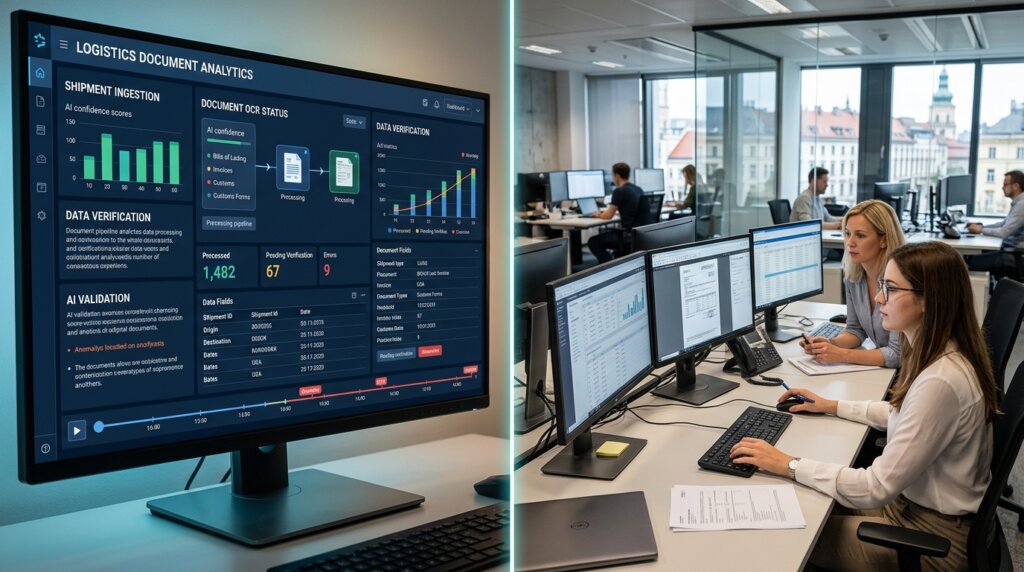
A software exception instantly translates to idle equipment in the yard. As soon as a truck arrives at the desk, the document processing begins. Paper waybills, packing slips, and customs documents are scanned and fed into an Intelligent Document Processing (IDP) system. For companies looking to scale their logistics AI pilot into production, it is crucial that this flow remains uninterrupted. This system uses optical character recognition (OCR) and algorithms to convert raw pixels into structured data for the Warehouse Management System (WMS) or Transport Management System (TMS).
With every data field extracted, the software calculates a confidence level. The algorithm uses this score to determine its own certainty about the read characters. If this score falls below a predefined threshold, automated processing halts for that specific document. To prevent data pollution, the system refuses to blindly push the information into the underlying databases, forcing a manual review instead.
The document exits the automated flow and lands at the bottom of the back-office exception queue. This is precisely where the direct link between software processes and physical yard congestion forms. How long the truck occupies the dock or waits in the parking lot depends entirely on the time elapsed between this AI failure and the final manual validation.
From Low Confidence Score to the Exception Queue
The mechanism behind this delay is simple. The software pauses and waits for input. An employee must open the digital queue, select the specific document, identify which field received a low confidence score, visually interpret the original scan, and manually enter the correct value. During peak hours, these digital exceptions pile up faster than the available back-office capacity can process them. The driver can only load, unload, or depart once the data is validated and released into the system. Ultimately, the turnaround time of the exception queue dictates the wait time of the driver.
The Reality of Logistics Documents
Out-of-the-box OCR models are typically trained on clean, structured datasets. However, physical logistics operations generate data that fundamentally deviates from these ideal laboratory conditions. Paper documents pass through multiple hands, truck cabins, and weather conditions before they ever reach a scanner.
The physical state of these documents prevents flawless digital reading. In practice, we frequently see coffee stains obscuring text, skewed scans from rushed desk work, faded ink from dot-matrix printers, and illegible stamps placed right over essential data fields. Drivers or warehouse staff often add hasty handwritten notes in the margins or cross out quantities to make corrections. Consequently, full automation has proven to be an illusion for many organizations striving for error-free processing without human intervention.
International CMRs present a unique challenge. Although the fields are numbered, the exact visual layout varies by issuing authority or country. Fields shift, boxes have different dimensions, or text overlaps. Standard AI models lack the operational context to correctly interpret these layout variations. At the slightest deviation from the expected pattern, the confidence score plummets, triggering an exception.
The Three Most Common Triggers for CMR Exceptions
When processing international waybills, we consistently see three main causes that stall the IDP system and require manual intervention.
Visual extraction errors: Physical damage to the paper, poor scan quality, folds, stains, and stamps that block the machine-readability of letters and numbers.
Structural layout issues: Deviations from the expected document template, such as shifted data fields, irregular table structures, or unexpected variations of the standard CMR format.
Logical errors: The absence of mandatory logical values. This occurs when a field is read correctly, but the content does not meet system requirements—such as missing HS codes, incomplete reference numbers, or total weights that don’t mathematically match the individual line items.
The Hidden Costs of Internal Queues
Idle equipment represents a direct financial drain. Delayed validation triggers a chain reaction of operational and financial damage. When trucks remain in the yard or at the dock longer than their allocated time slot, demurrage and detention charges kick in. Carriers pass these waiting hours directly on to you.
The impact extends beyond the physical yard and strikes at the heart of the back-office operation. Logistics is a business of sharp peaks. A surge in incoming trucks means an immediate surge in incoming documents and, due to inevitable fall-out, a spike in the exception queue. To keep the yard running, the back office is forced into structural overtime. Solving this bottleneck simply by hiring extra local staff structurally fails. The labor market for administrative personnel is tight, and scaling capacity locally is expensive and inflexible. Ultimately, the internal queue limits the maximum throughput capacity of the entire logistics hub.
Calculation Example: The Cumulative Impact of a 15-Minute Delay
The true impact of a slow document flow only becomes visible when the time per unit is extrapolated to daily volumes.
Daily volume: 100 incoming trucks
Average wait time due to AI exceptions and slow validation: 15 minutes per truck
Lost time per day: 1,500 minutes (25 hours)
Lost time per week (5 working days): 125 hours
Even at a modest volume of 100 trucks per day, a 15-minute wait costs the operation 125 hours of blocked dock capacity and idle equipment every week. This translates directly to lower turnover rates, penalty clauses, and unnecessary pressure on the yard.
Acknowledging the Limits of Automation
The expectation that pure software can provide 100% error-free processing of unstructured logistics data does not align with reality. Technological solutions are powerful, but the varying quality and complexity of physical source data guarantee a continuous stream of exceptions. Chasing full automation only leads to gridlocked processes.
A robust process design acknowledges this technological limit. It requires a built-in, scalable ‘human-in-the-loop’ component. This component is specifically designed to immediately catch the inevitable exceptions. Certain documents result in hard rejects—scans that are so damaged, non-standard, or illegible that the algorithm yields no usable output. To maintain continuity in the yard, a seamless transition to a hybrid working model is necessary, where technology does the heavy repetitive lifting and human intelligence steps in instantly for complex or non-standard data.
The Foundation of Scalable Human-in-the-Loop Validation
Human validation should not be an ad-hoc stopgap to fix the shortcomings of the IT system. It must form a fully-fledged, integrated part of the process architecture. When volumes in the yard surge, the capacity to handle exceptions must scale synchronously. A scalable validation process ensures that data is checked, corrected, and enriched in real time. Only with a firmly anchored human control layer can you prevent a hiccup in the algorithms from turning into hours of delays at the dock.
Conclusion & Next Steps
The throughput speed in the yard is directly determined by the speed of document processing. Because unstructured logistics documents inevitably cause AI failures, these exceptions lead to idle trucks, capacity loss, and mounting costs without rapid validation. A hybrid process design with integrated human oversight prevents these bottlenecks.
DataMondial acts as your BPO partner to seamlessly absorb these administrative hurdles at scale. From our nearshoring facilities in Romania, we provide EU-compliant data validation for OCR, AI, and machine learning, as well as document processing and back-office outsourcing. By combining RPA and AI with our human expertise, we guarantee Data Accuracy and ensure your exceptions are resolved instantly, so your physical flow never stops. Contact us to discuss how we can accelerate your back-office and operational turnaround times.