The Hostage Effect: Why One Data Error Traps Your Entire LCL Container at Customs
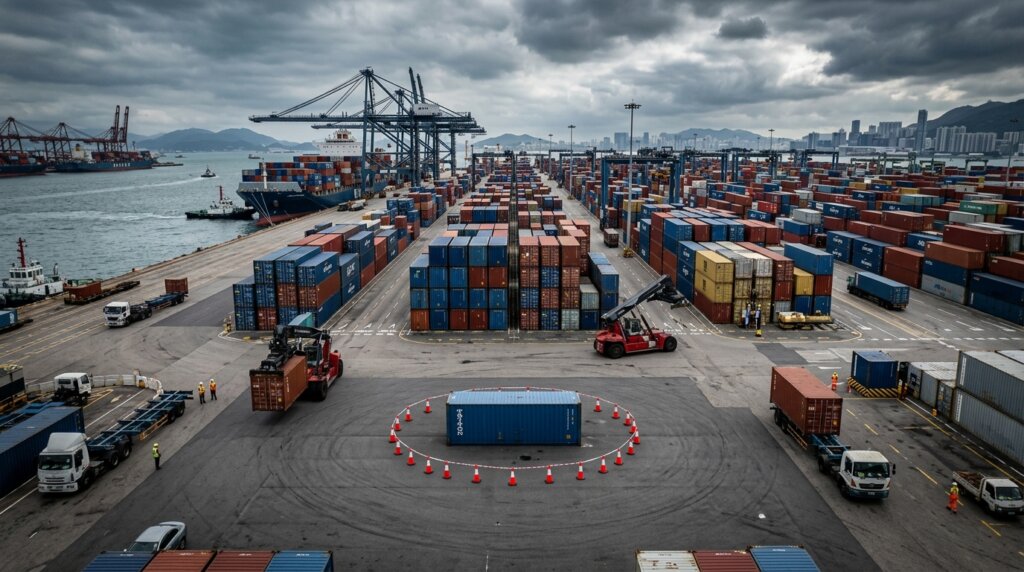
Title: The Hostage Effect: Why a Single Invalid Line of Data Traps an Entire Consolidated Container at Customs
Primary keyword: customs delays LCL shipments
What causes a collective customs hold on consolidated cargo?
One missing HS code in shipment A acts as an immediate stop sign for the entire consolidated container. As soon as the customs clearance of a single partial delivery stagnates, the customs system blocks the status of the entire load. Consequently, shipments B through Z are systematically trapped on the terminal until the problematic shipment’s file is fully resolved. DataMondial’s expert back-office outsourcing for logistics helps prevent such bottlenecks through rigorous gatekeeping. Customs systems perform their physical profile analysis based on the master manifest. This method, firmly rooted in the Union Customs Code (UCC), screens both import and export flows for anomalies via automated controls. The moment the algorithms detect an administrative vacuum, the system automatically pauses the release procedure of the physical unit. Retrospective file audits then mandate that the terminal operator places the respective consolidation unit on immediate ‘stop-hold’.
Fundamentally, delays caused by administration are entirely avoidable. This forms a sharp contrast with mandatory physical checks. A random drug scan at the terminal falls within standard operational margins; no amount of optimized data structure or system enrichment outweighs a customs mandate focused on maritime security and narcotics. Administrative holds, however, completely lack this element of force majeure. Missing tariff details, typing exceptions, or invalid value declarations originate entirely upstream, emerging exclusively as a direct result of inadequate data validation.
The master manifest as the weakest link
Customs IT architectures reduce supply chain complexity by consolidating Less than Container Load (LCL) bookings into one strict analytical profile. The physical unit—the steel sea container—is inextricably linked to the master manifest across both the terminal message and the customs declaration. The customs information system strictly interprets this overarching manifest not as a loose collection of files, but as one centralized entity. To safely navigate this logic, the flawless processing of customs documentation is essential to guarantee seamless throughput.
An inaccurate declaration buried deep within the hierarchy of an underlying document triggers a universal ‘not approved’ status for the master reference. As soon as the algorithm registers an asymmetrical relationship between the reported cargo and the registered commodity code, it generates an immediate system alert. In doing so, the customs dossier secures the import and export zone in accordance with excise and direct tax obligations. As long as a single line of text or weight indicator inside the LCL box deviates from either reality or regulation, the port authority will decisively refuse the Release of Cargo. Almost instantly, the consolidated container mutates from a highly efficient logistics solution into a cripplingly expensive storage facility directly on the port premises.
Financial consequences of administrative delays
The compounding impact of port fees activates the very second the allocated ‘free time’ expires. A consolidated shipment instantly begins accumulating hidden daily costs the moment a terminal holds the container on site. These demurrage charges represent the direct rental cost of the terminal space per unit. Furthermore, terminals operate using a progressive, tiered pricing structure. The initial daily demurrage rate cyclically escalates into a higher price category, multiplying the daily holding costs the longer a delay lasts. Subsequent to this, the shipping line leverages detention charges; a rigid financial penalty aimed at the extended use of their steel equipment well beyond the mutually agreed delivery timeframe.
This financial impact ripples aggressively toward the external carriers involved in the chain. Transport planners routinely dispatch trucks to the terminal to collect released goods. If the container is systematically rejected based on administration, the driver simply will not receive the release PIN required for pickup. Hauliers invariably bill for this unplanned downtime via substantial hourly waiting rates. If a driver is forced to leave the terminal completely empty-handed, it counts as an ’empty leg’ or dry run—the total cost of which is fully charged back to the orchestrating freight forwarder or consolidator.
Calculation example: The real impact of a 4-day terminal delay
A customs hold quickly culminates into an exponential surge in correction expenditures. Typically, a terminal offers standard free days. However, once an administrative error results in a hold lingering four days beyond this free window, the margin on the consolidated shipment totally evaporates. Consider a factual example based on standard fee structures for a 40-foot unit at prominent container hubs like ECT Rotterdam or PSA Antwerp:
- Free Days (Days 1 to 3 via the shipping line): Zero financial premium applied to demurrage or detention. However, this period still inflicts highly costly downtime within your broader operational flow.
- Days 1 and 2 stretching beyond free time: The terminal sparks the basic Demurrage charge (€95 per day). Additionally, the carrier activates the basic Detention levy (€75 per day). Total damage: €170 daily. Over a two-day span, this totals €340.
- Days 3 and 4 stretching beyond free time: The progressive pricing tier actively kicks in. Demurrage leaps to Tier 2 (€140 per day). Detention remains steadily linear (€75 per day). Total damage: €215 daily. Over a two-day span, this totals €430.
- Additional logistical damages: Amidst this hold, a booked haulier conducts a dry run valued at €350, while additionally logging 2 hours of waiting time billed at €65 per hour.
The concrete total for a relatively short four-day delay suddenly amounts to €1,250 layered on top of the initial freight expenditures. A shockingly simple data asymmetry fully eliminates the profitability of the entire shipping journey.
MBL and HBL discrepancies as the primary culprit
The back office routinely manages highly complex data registrations acting as the primary ignition mechanism for the full export and import cycle. Freight forwarders meticulously build the transport file upward from individual shipments, relying on the House Bill of Lading (HBL). The party consolidating the sea freight then funnels these underlying groupage files into the Master Bill of Lading (MBL) designed for the carrier. Data validation dependent on purely manual entry, often fragmented across multiple strictly isolated Transport Management Systems (TMS), easily breeds risky asymmetry between the master document and the house iterations.
A deviation occurring between these two foundational levels serves as a blaring red flag for the overarching electronic customs network. The flawless matching of MBL and HBL documentation guarantees that all individual shipment data structurally corresponds one-to-one with the combined totals at the master tier. Deficient data correlations enforce immediate manual intervention during the clearance pathway; forcing the forwarder to systematically amend the formal customs file. Naturally, this pushes new data transmissions toward the terminal, severely delays the risk analysis framework, and racks up arbitrary document correction fees per individual request.
The top 3 data traps in LCL manifests
Specific data metrics function strictly as a catalyst for automated system stops. When the fields below present an asymmetrical configuration, the governmental portal is explicitly programmed to activate a blockade:
- Conflicting gross weights: The consolidated gross weight on the MBL must perfectly mirror the mathematical sum of the specific weights noted in the individual HBLs. A seemingly trivial rounding error of just 0.5% acts as viable grounds for a major discrepancy alert. Customs systems systematically flag this as a critical risk factor tied to undeclared goods or deliberate tariff code manipulation.
- Incorrect package counts: The HBL files detail explicit packaging units—such as loose cargo, individual pallets, or “150 cartons”. Frequently, the MBL condenses this dense data far too abstractly, consolidating it as an unspecific “3 pallets”. This drastically mismatched piece count forces customs systems to flag these unexplained physical transformations as an exceptionally high-risk supply chain profile.
- Contradictory cargo descriptions: A local client’s shipment might explicitly state “auto parts – lithium batteries” on the underlying HBL. However, when consolidating and packaging this, the consolidator logs the overarching load vaguely within the TMS as “Consolidated cargo – machinery” on the final MBL. The algorithm quickly detects strong evasion indicators relating to dangerous goods classifications, instantly springing the stop-hold trap.
Guaranteeing data integrity prior to submission through structural process adjustments
Shifting data enrichment procedures from post-arrival firefighting to robust data validation pre-departure is undoubtedly the most effective modality for incident reduction. Leading logistics operators deploy automated checks and deep visual verification protocols the exact moment documentation is received. By securely ironing out shipment data thoroughly during the early export phase, the central file bypasses later friction points once hitting the importing customs authorities. Implementing specialized external solutions permanently neutralizes the inherent vulnerabilities of internalized operational silos.
Effectively validating LCL risk profiles thrives almost exclusively through fiercely disciplined procedural frameworks. Domain-specific data entry agents focused fully on international transport logic evaluate manifest declarations governed by meticulously defined decision trees. They rigorously verify, mutate, and administer incoming documentation through locked EDI connections or integrated web portals. Relying on this structural process approach ensures an organization anchors operational reliability, as dedicated data quality frameworks act as a permanent guardian over customs tariffs and projected delivery bandwidths.
Hybrid data processing as the ultimate compliance solution
The vast, voluminous information flows strictly inherent to LCL cargo force logistic Back Operations to fundamentally embrace highly scalable architectural models. An intelligently crafted blend centering on RPA (Robotic Process Automation) technology heavily supported by human capital precisely answers these escalating capacity demands. Crucially, RPA guarantees instant machine-reading alongside fluid data extraction. Advanced bots structurally evaluate standardized input fields (such as item counts alongside unit weights) scattered across 50 distinct HBLs at warp speed, perfectly distilling the consolidated arithmetic for the final MBL.
Should the RPA module encounter a severe asymmetry, such as a totally absent input variable nestled within a reference description, it immediately pauses automated transmission. The system intuitively isolates this specific exception and stages it for immediate review. Tightly orchestrated human oversight natively functions as the resolution gateway here. Our specialized data team visually verifies the error directly referencing the original digitized source document, flawlessly corrects the impacted TMS field, and subsequently releases the data packet. This hybridized structural approach heavily guarantees EU compliance: customized algorithms expertly plow through massive volumes, while dedicated domain specialists proactively defend definitive file health.
End-to-end data integrity heavily shields vital logistics operations against financially destructive demurrage penalties and deeply derailed container scheduling flows. Ultimately, flawlessly aligning exact manifest fields surgically eliminates LCL customs bottlenecks directly at the genesis point. DataMondial stands out as the distinguished BPO operational partner built for expertly scaling intensely targeted data configurations out of fully GDPR-compliant nearshoring facilities based in Romania. Commanded by highly experienced Dutch project managers, we boldly converge exceptionally advanced RPA capabilities with rigid, uncompromising human oversight purely to drive 100% Data Accuracy outcomes. For a perfectly streamlined, worry-free cargo import lifecycle, look to our proven expertise in comprehensive back-office support for the logistics sector. Definitively neutralize your administrative error margins natively via scalable, intelligently hybridized document validation channels and effectively streamline your entire logistics operations today.