Why Your Logistics Platform Floods You With False Alarms (And How to Cure Supply Chain Alert Fatigue)
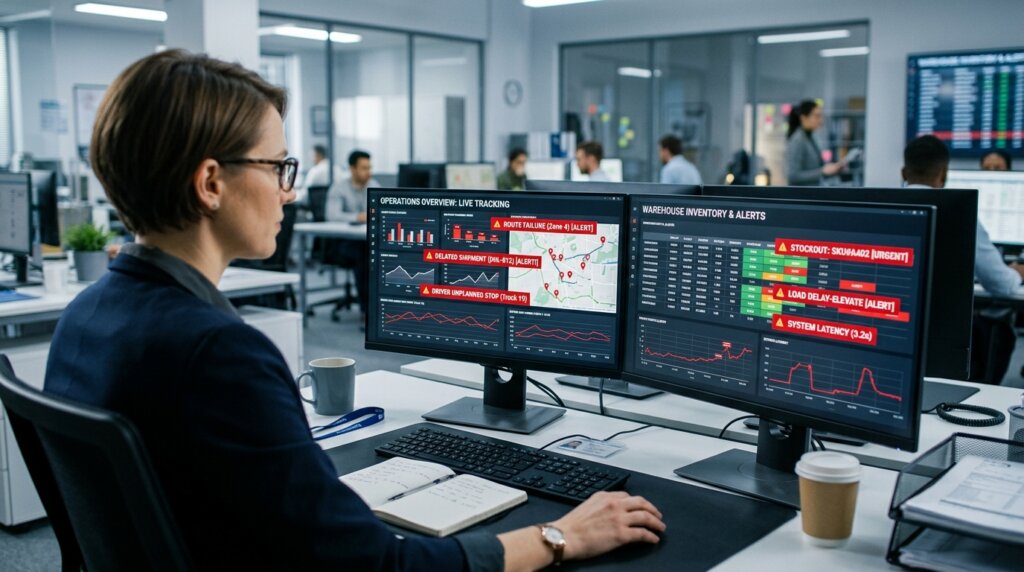
Flawed data entry is the root cause of an unreliable overarching dashboard. Every day, thousands of data points flow through the supply chain into systems like a Transport Management System (TMS) or a control tower. When planners are constantly dismissing pop-ups and warnings, it rarely means the supply chain is actually on fire. Instead, it points directly to a fault line between manual data entry at the back-office outsourcing for logistics level and the downstream processing by underlying systems.
The root of this system noise often lies in asynchronous updates within forwarding software. For example, a freight forwarder might change the departure date in a local system, but due to delayed synchronization, this update fails to reach the overarching dashboard in time. The system flags a discrepancy between the planned and actual status, generating a warning. Another structural issue stems from duplicate customs documents. When a freight document is entered twice with a minor variation in the reference number, the system launches two parallel workflows. Once the physical shipment moves, the ‘ghost booking’ is left behind, resulting in persistent red flags for a shipment that has actually already been delivered.
The slow manual transfer of ETAs (Estimated Times of Arrival) from PDFs or emails into the operational system also triggers false signals. While the physical truck might already be at the warehouse dock, the system flags the shipment as delayed because the updated ETA was never processed. To prevent operational teams from wasting valuable hours chasing down these data errors, a strict diagnostic framework is required.
The anatomy of a false supply chain alert
To separate administrative backlogs from actual logistics bottlenecks, planners must be able to instantly determine whether an alert stems from data decay or a genuinely stalled shipment. Outdated or unvalidated data triggers algorithms in the exact same way as a physical hold-up at a border control.
Checklist: Administrative lag or real physical blockage?
Use the following five data points to verify the origin of a notification before initiating an operational escalation:
- Scan time vs. system update: Compare the timestamp of the last physical barcode scan with the time the record was updated in the TMS. A significant gap indicates a data entry backlog.
- Customs reference deduplication: Check whether the MRN (Master Reference Number) or waybill relates to a documentation flow that has already been processed under a different internal file number. This prevents the erroneous processing of customs documents within the system.
- API status check: Verify whether the status in the standalone forwarding software matches the control tower status exactly. Discrepancies point to faltering asynchronous connections.
- ETA mutation log: Review the revision history of the ETA field. A static, unchanged ETA for a shipment that has already passed multiple transit points strongly suggests forgotten manual updates.
- External validation at the source: Check the current container or trailer status directly via the carrier’s or shipping line’s native portal to benchmark local system data against current reality.
The hidden costs of operational blindness
In practice, supply chain alert fatigue directly drains FTE capacity and structurally weakens risk management. Planners facing hundreds of system warnings a day inevitably develop a blind spot for anomalies. The operational reality forces these employees to primarily chase ‘ghost delays’: alerts about shipments that are physically on schedule but administratively lagging.
This workload breeds a ‘mark-as-read’ culture. Employees dismiss batches of warnings just to keep their dashboards manageable. Because of this routine, critical escalations—like a container stuck at customs for inspection—go undetected amidst the noise of administrative data errors. The organization’s ability to proactively intervene during real incidents essentially vanishes.
Calculation example: The hard daily cost of 50 false notifications
To illustrate the impact on budgets and daily continuity, here is a breakdown of the time and costs associated with system noise in a mid-sized back office:
- Volume of false alerts: 50 per day, per branch.
- Verification time: At least 10 minutes per alert (investigating source systems, calling carriers, cross-referencing emails).
- Daily time investment: 500 minutes (8.33 hours).
- Operational impact: More than one full-time, specialized FTE spends an entire workday resolving unnecessary warnings instead of focusing on capacity planning or client communication.
- Missed savings: The labor costs of these wasted hours add up to thousands of euros in monthly inefficiency—not to mention the downtime costs incurred from missing actual incidents (such as demurrage and detention charges).
Why raising software threshold values doesn’t work
A common, reflexive response to alert fatigue is to recalibrate dashboard warnings. IT departments often suggest widening the tolerance margins: setting the software to only generate an alert after a 24-hour delay instead of a 4-hour one. However, treating the symptoms only masks the underlying flawed data.
Relaxing the alert rules in a TMS or control tower means accepting polluted data as the operational standard. This tolerance erodes the resilience of the entire supply chain. Decisions regarding alternative routing, consolidation, or cross-docking end up based on inaccurate time windows. True scalability requires strict protocols and exact data; systems operating with intentionally built-in margins lose their predictive value. This advice is specifically geared toward managing administrative data hygiene for supply chain control towers. For streaming data, different rules apply.
The limits of this advice: IoT sensor data vs. documentation
There is a clear distinction between signal noise from hardware and sloppy human data entry. IoT sensors in reefer containers continuously monitor variables like temperature or humidity. This raw streaming data inherently contains natural fluctuations caused by defrost cycles or opening doors. Iteratively calibrating and smoothing this data flow through algorithms is a technical necessity to extract actionable intelligence.
Conversely, an ETA on a waybill, a customs certificate, or an Incoterm does not feature natural fluctuations. An error in these parameters is exclusively the result of incorrect or missing human input. Where sensor data demands calibration, sloppy data entry demands protocols.
Back to basics: Sanitizing source data for the control tower
The foundation of a reliable supply chain dashboard lies in centralizing and streamlining the data entry process. The path to data accuracy requires a strict separation between automated API data connections and human validation of documentation.
When complex, unstructured customs and shipping documents flow directly into a database via OCR (Optical Character Recognition) without an interpretation protocol, it generates the exact data errors that lead to the aforementioned system warnings. Technologies like Robotic Process Automation (RPA) accelerate the transfer of structured fields, but logistics reality often consists of irregular PDF formats, handwritten notes on CMR waybills, and incomplete packing lists. Here, data hygiene requires a tightly managed back office that catches these exceptions before the raw data ever reaches the core logistics system.
Given the tight labor market, the logistics sector is increasingly turning to strategic BPO solutions. Nearshoring delivers the necessary structural data processing capacity without compromising on compliance. By delegating data entry to specialized teams outside the primary operation, back-office processes continue to run with consistent quality, allowing local planners to focus purely on actual exception handling of physical freight.
Standardizing data entry protocols in practice
To tighten the interpretation of raw forwarding documents by back-office staff and feed the API with pristine data, organizations should implement the following action points:
- Implement a digital quarantine zone: Block documents with missing or mismatched key fields (such as conflicting container numbers) from automated transfer until an employee manually verifies them.
- Create ‘if-this-then-that’ interpretation matrices: When processing unstructured documents, specify exactly which date field takes precedence if a supplier lists multiple transport dates on a single form.
- Centralize exception handling: Ensure documentation discrepancies follow one defined process, guaranteeing the data entry method for problematic files is identical and doesn’t rely on individual employee discretion.
- Combine RPA with human-in-the-loop oversight: Let scripts execute routine data extractions, but mandate highly trained professionals for the final validation of customs and dangerous goods documentation before they enter the control tower.
Incorrect and unvalidated data entry in logistics back-office systems serves as the primary engine driving supply chain alert fatigue, leading to hidden costs and a loss of responsiveness during acute supply chain disruptions. Sanitizing data entry streams for the control tower and distinctly separating administrative lags from physical obstacles will stop the constant influx of false warnings. DataMondial, a Dutch company specializing in BPO, facilitates this operational transition from three EU-compliance-proof Operations Centers in Romania. Contact us to discover how a specialist in data processing and back-office support can relieve your internal teams, guarantee data quality, and seamlessly strengthen your competitive position.