The Hidden Cleanup Costs of ‘One-Click’ Supplier Imports in Your PIM System
The Gap Between Theory and Data Reality
Unstructured product data is a direct drain on operational margins. A Product Information Management (PIM) system is designed to serve as the central, authoritative source of truth for all product information. For any hybrid approach to content management that demands high accuracy, correct data processing is non-negotiable. Acquia’s guide “What Is PIM? Product Information Management Guide (2026)” describes the architecture as an instrument for harmonizing data. The operational reality, however, tells a very different story the moment theory meets live supplier feeds. Expensive PIM investments stall when unfiltered data flows straight into the system.
Operational teams lose valuable hours every week tracking down and correcting incomplete or inconsistent product data that enters the platform through automated import functions. Professional web research and content management services can significantly reduce this burden on the organization. This article focuses on the measurable impact of these unfiltered data streams — and makes a clear case for why the absence of validation undermines the very ROI that enterprise PIM systems are supposed to deliver.
Why Automated Data Mapping Fails in Practice
A technical data connector verifies whether a file type is correct — it does not check whether the content is operationally usable. The gap between external source data and internal data structures exists because trading partners simply do not follow uniform standards. Supplier feeds typically arrive as flat, loosely structured Excel sheets or outdated XML files. These source documents lack the specific hierarchy and strict field requirements that an enterprise PIM system demands.
A so-called “successful import” via an API or one-click module forces the data somewhere into the system. As discussed in the industry thread “Would a ‘supplier feed normalization layer’ before the PIM …” on Reddit, direct supplier imports often lack a necessary normalization layer. Values that the internal mapping rules cannot recognize are dumped by the software into undefined, free-text fields. There is one clear exception: sectors that operate strictly in accordance with GS1 Data Source standards receive source data that is pre-bound to fixed norms. Outside those specific, controlled supply chains, inconsistent product specifications lead to structural data problems. The publication “PIM Product Information Management: Definition & Use” by Activo Consulting demonstrates that precise matching of product attributes is critical to catalog functionality.
Below are the three most common mismatches that occur when unvalidated feeds hit a rigid PIM.
Category MismatchSupplied Data (Supplier)Required Data Structure (PIM)Result of Automatic ImportDimensions“L: 12inch x W: 5inch”Length (cm), Width (cm) (numeric)Values ignored or written as plain textClassifications“Outdoor >> Garden >> Lighting”ID-based category treeProduct falls into residual category ‘Unknown/Other’Attributes (Color)“Midnight Blue 001″Standardized primary colorError message or mapping to generic ‘Blue’ without specification
The Risk of Free-Text Categories
An open architecture without strict validation forces the back office into structural, manual investigation. Once product parameters land in free-text fields or undefined residual categories, they become a blind spot for the entire ordering and search system. Plain text cannot be filtered on e-commerce platforms and cannot be read numerically by adjacent back-office applications. As a result, staff must interpret and manually reclassify the uncategorized data record by record to restore the required level of data accuracy.
The Domino Effects of Invisible Errors
Incorrect or incomplete product information does not stay isolated within the PIM environment. Raw data leaks unchecked into every operational and logistics process connected to the PIM. The publication “Manage and Share Multi-Supplier and Retailer Data Easier” by Plytix describes how complex data points from multiple suppliers flow through the PIM network and directly influence procurement and sales workflows. Inconsistent dimensions pose an immediate risk. When a U.S.-based supplier delivers measurements in inches and the PIM blindly accepts them — instead of converting to the required centimeters — automated warehouse calculations break down. Packaging machines determine the wrong box size, or the software calculates incorrect pallet dimensions.
A harsh reality in the supply chain emerges with return shipments caused by incorrectly stored product weights. Carriers plan vehicles based on the weight data in the system. If the PIM erroneously records a weight of 1,500 grams instead of 15 kilograms per unit, the actual overload at the dock leads to rejected shipments and additional freight costs. These iterative corrections across the chain result in delayed time-to-market and directly attributable lost revenue. In the report “PIM Data Quality: How to Measure, Score & Fix Your Product…” by LynkPIM, this revenue leakage is explicitly linked to a lack of structural data governance.
Logistics Process Gridlock
Physical and administrative logistics grind to a halt when the governing PIM data fails. Customs documentation is a prime example. Missing or incorrectly mapped HS codes (Harmonized System tariff codes) in the dataset block the automated generation of export documents. Customs agents suspend processing until the correct codes are manually supplied. At the same time, PIM attributes dictate internal logistics. Warehouse Management Systems (WMS) reserve pick locations based on stored hazard classes and dimensions. Incorrect or empty values lead to improper placement of goods in the warehouse, disrupting route planning and the physical efficiency of warehouse staff.
The Cost Model: The True Price of Data Cleanup
Manual workarounds create a silent budget drain. For a COO or CFO, the impact of poor-quality data can be clearly quantified through an estimate of lost labor hours. When specialized employees spend time every week smoothing out recurring errors in supplier feeds, available capacity quietly bleeds out of the organization.
The financial impact of this operational leak is concrete. An operations department where four employees each spend five hours per week deciphering free-text fields and correcting basic data entry errors registers an annual loss of 1,040 hours. That represents exactly 0.5 FTE of repetitive correction work that adds zero new value to the business.
This mandatory allocation of labor hours undermines the initial ROI projection for the PIM software. Instead of strategic catalog expansion, time is consumed by micro-level data management. LynkPIM confirms this burden in “PIM Data Quality: How to Measure, Score & Fix Your Product…”, presenting the invisible costs of manually consolidating and fixing raw product data as fixed cost items that should be factored into the software implementation from the outset.
The Limits of Unsupervised Automation
A technical implementation does not reason — it executes. Technology without active human oversight and contextual judgment is fundamentally vulnerable to structural data pollution. Automation tools and API connectors import data at high speed, but importing faster does not solve a quality problem.
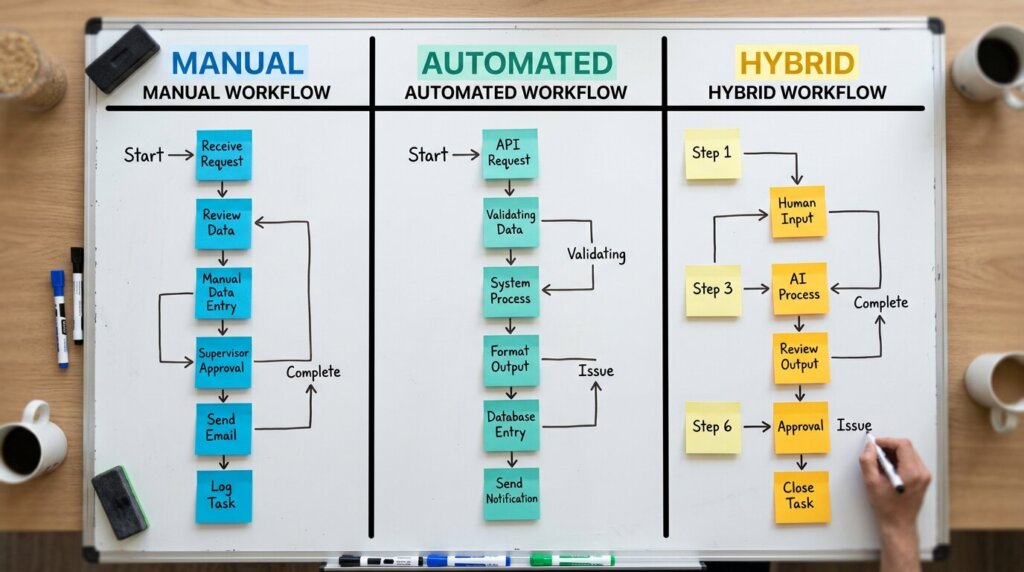
When you push unfiltered product details through mechanisms built purely for acceleration, the tool simply multiplies the volume of both usable and unusable attributes. The Bluestone PIM case, as analyzed in the presentation “How to Onboard Supplier Data into a PIM System 3 Methods,” demonstrates that directly routing supplier systems into an internal platform requires a controlled intermediate layer. The practical examples and forum discussions converge on the same principle: a validation layer is needed before the PIM is ever fed. Combining RPA with human oversight creates a closed filter against external inconsistencies.
The Danger of Blind Acceleration
Robotic Process Automation (RPA) moves data linearly from point A to point B based on pre-programmed paths. If a new Excel dump from an overseas partner is missing the currency indicator column, a purely technological setup may overwrite those values as euro amounts on the e-commerce site. Without the watchful eye of a data analyst in the workflow, the error propagates through the company’s own network. Accelerating processes without built-in verification ultimately undermines overall scalability.
Stable Operations Require Control at the Gate
Data-driven processes demand the alertness of human professionals to structure and logically validate the abstract values from diverse supplier sources. A hybrid approach to content management stops the chain reaction of flawed information before logistics or financial systems adopt the erroneous values. Safeguard your PIM implementation and capacity by entrusting efficient data cleansing and web research to DataMondial — a specialist BPO organization with a robust nearshoring facility in Romania. This focus guarantees reliable, scalable data processing and full EU compliance at a structurally lower cost. Strengthen the quality of your back office today by scheduling an introductory consultation.