How Back-Office Outsourcing Streamlines Ocean Freight Rate Processing
Logistics rate management: The impact of manual ocean freight rate processing
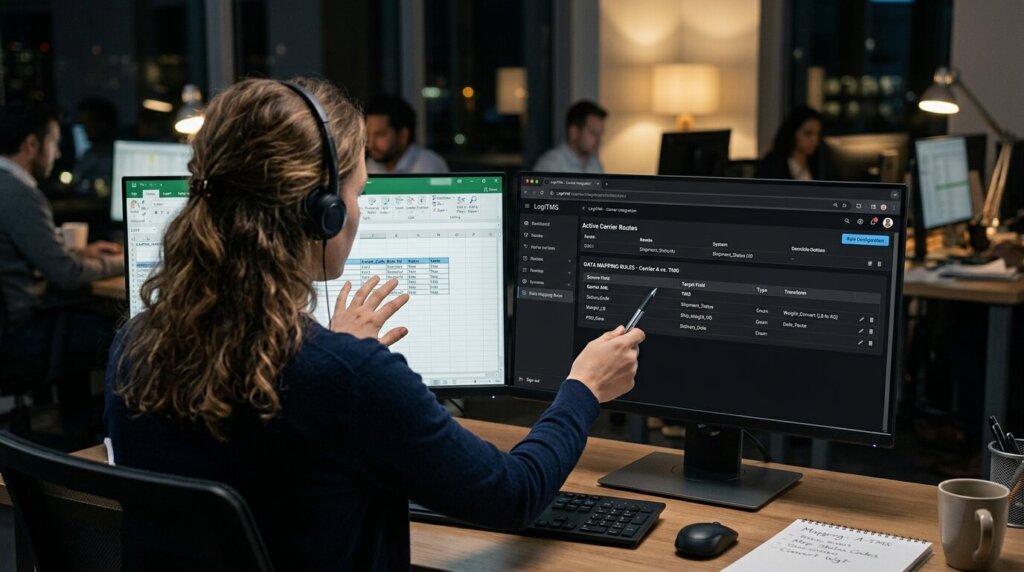
The manual processing of ocean freight rates creates hidden costs within logistics operations. Every day, personnel lose valuable hours manually re-keying rates, processing complex shipping documentation, and updating shipment tracking systems. This workflow not only creates bottlenecks in the flow of information but also introduces structural errors into your administration. A single typo in a freight rate or a miscopied detail in shipping documentation directly leads to incorrect invoicing or border delays. What is this inefficient handling ultimately costing your organization? Streamlining ocean freight rate processing lowers operational costs and drastically reduces your error margin.
The bottlenecks within logistics rate management
Logistics processes stall internally when the administrative burden grows faster than available capacity. Within logistics rate management, there are three structural bottlenecks.
First, disparate delivery formats—such as PDFs, Excel spreadsheets, and emails—hinder the automation of logistics documentation. Second, qualified personnel in the logistics administration office are forced to spend a significant portion of their day on data entry and verification. This detracts from vital supportive tasks such as advanced document processing and client communication.
Third, errors in freight forwarding documentation and customs paperwork lead directly to financial and operational damage. Incorrect data entry can result in terminal delays, additional storage fees, or compliance fines.
The lack of standardization in delivery formats
Shipping lines and freight forwarders use a wide variety of formats for rates and documents. The entire chain of freight forwarding office documentation and shipping documentation suffers from a lack of a unified standard.
As a result, direct automation within TMS and ERP systems is practically impossible without human oversight. Non-standard columns, hidden surcharges, and inconsistent currency formats dictate that data must first be manually standardized before processing can take place.
Suboptimal allocation of qualified personnel
Within the logistics administration office, highly trained employees are largely deployed for repetitive tasks like data entry and document verification.
While this role is supportive in nature and essential for accurately moving information through the operational chain, it leaves these professionals with less time for higher-value activities, such as proactive file preparation or client support.
The hybrid approach: RPA combined with data management
In reality, full automation natively struggles to be 100% reliable within the logistics back office. That is why industry leaders apply a hybrid model: Robotic Process Automation (RPA) handles structured data extraction, while a “human-in-the-loop” provides essential validation.
RPA processes standardized logistics documentation and freight forwarding documentation, automatically routing anomalies to dedicated specialists for review. This significantly lowers the error margin and increases the reliability of customs paperwork and rate processing.
Why full automation falls short
While OCR (Optical Character Recognition) technology performs well on uniform documents, it frequently fails when confronted with unstructured shipping documentation and freight forwarding documentation.
Handwritten notes, poor-quality scans, and variable formats cause data to be read incompletely or incorrectly. Without human validation within the logistics administration office, these extraction errors flow directly into ERP and TMS systems, creating downstream failures.
The data flow in a hybrid back office
Data processing within the logistics back office follows a highly controlled chain of custody:
Ingestion: Incoming ocean freight rates and shipping documents are centralized in a digital inbox.
Extraction (RPA/OCR): The internal technology scans the documents, automatically extracting known data fields such as ports of loading/discharge, container types, base rates, and surcharges.
Human validation: The systems systematically flag ambiguous cases, such as low-confidence OCR reads or unfamiliar supplier formats. Specialists within the logistics back office and logistics administration office manually verify this data for absolute accuracy and correct the output.
Import: The verified, approved data flows cleanly into the client’s ERP or TMS via an API integration or a secure connection.
Nearshoring vs. offshoring for logistics back offices
Outsourcing ocean freight rate processing requires a carefully considered location strategy. In practice, logistics BPO (Business Process Outsourcing) is divided into nearshoring (within Europe) and offshoring (distant locations like Asia). Business continuity and compliance frameworks heavily drive this decision. Nearshoring within the EU facilitates seamless daily management and completely safeguards the legal protections surrounding your data.
CriteriaNearshoring (EU, e.g., Romania)Offshoring (e.g., Asia)Time zoneDirect overlap due to comparable working hours.Significant time difference, limited shared hours.ComplianceFull GDPR application (strict data security).Complex legal structures, data leaves the EU.CommunicationHigh multilingualism and European business culture.Language barriers and differences in interpreting instructions.
The role of time zones in processing speed
Speed is critical to the daily operations of any logistics management office. When an error is discovered in shipment tracking, a rate needs adjustment, or a document requires updating, the clock dictates how quickly a shipment can be released or corrected.
International supply chains frequently suffer from a timezone mismatch between European teams and offshore locations. A correction requested during the European workday might not be addressed in some global regions until the following business day. This lag can cause an unnecessary 24-hour delay in processing and administrative finalization.
That delay eventually cascades through multiple layers of the organization: downward from the logistics back office right into operational planning. A single delay in document processing can result in terminal waiting times, extra demurrage and detention charges, or missed vessel cut-offs.
By utilizing nearshoring teams in the same or overlapping time zones, this structural delay is practically eliminated. Teams can act immediately on exceptions in logistics documentation or customs paperwork, ensuring that vital corrections are finalized within the very same business day.
GDPR compliance and data security
Logistics processes handle massive amounts of sensitive data daily via customs paperwork and freight forwarding documentation. This includes Personal Identifiable Information (PII) of importers, exporters, drivers, and consignees, as well as highly confidential commercial intelligence like agreed rates and internal contractual agreements.
Within the European Union, this data is thoroughly protected under the strict regulations of the General Data Protection Regulation (GDPR). Organizations are legally obligated to handle the storage, processing, and transfer of data within the logistics chain with the highest standards of care.
EU-based nearshoring offers a critical, structural advantage here. Because the entire processing workflow occurs within the exact same legal framework, your data remains fully protected under European law. This not only minimizes the operational risks of data breaches but also proactively prevents the severe legal complications and fines associated with processing confidential data outside EU jurisdictions.
Transparency is equally vital. By utilizing European nearshore operational teams, organizations find it far easier to execute audits, exercise process control, and ensure absolute compliance within their overarching logistics administration and management frameworks.
When logistics back-office outsourcing does not yield ROI
Outsourcing is an unequivocally powerful solution for scaling high-volume, structured data, but avoiding incompatible scenarios is vital to securing genuine operational success. Logistics back-office outsourcing simply does not yield a return on investment for small trading companies or micro-forwarders handling fewer than 50 shipments a month. Implementing RPA frameworks and successfully establishing an external control flow in the supply chain office requires a predictable baseline scale to justify the initial integration costs.
The same logic fundamentally applies to organizations plagued by structural process chaos within their own logistics back office. Logistics BPO necessitates a foundational dataset, standardized business rules, and transparent Service Level Agreements (SLAs). An ad-hoc process continuously affected by shifting instructions and a failure to enforce standard workflows in the logistics administration office cannot be effectively handed over or sustainably automated. Strategic outsourcing amplifies excellent process design; it does not replace the fundamental business policies of a functional logistics coordinator.
Conclusion and next steps
The manual processing of ocean freight rates aggressively inflates hidden costs and dramatically multiplies error margins across both logistics rate management and logistics documentation setups.
Integrating a hybrid automation model within the logistics back office, fully supported by a high-performing logistics administration office and strategic logistics management office, guarantees a much leaner, significantly more accurate, and heavily scalable operational footprint.
Discover how DataMondial’s EU-based nearshore experts can transform your ocean freight rate processing through our powerful combination of advanced RPA technology and precision human validation.