Why Slow Document Processing Sabotages Your Cross-Docking Strategy
The Disconnect Between Physical Throughput and Data Entry
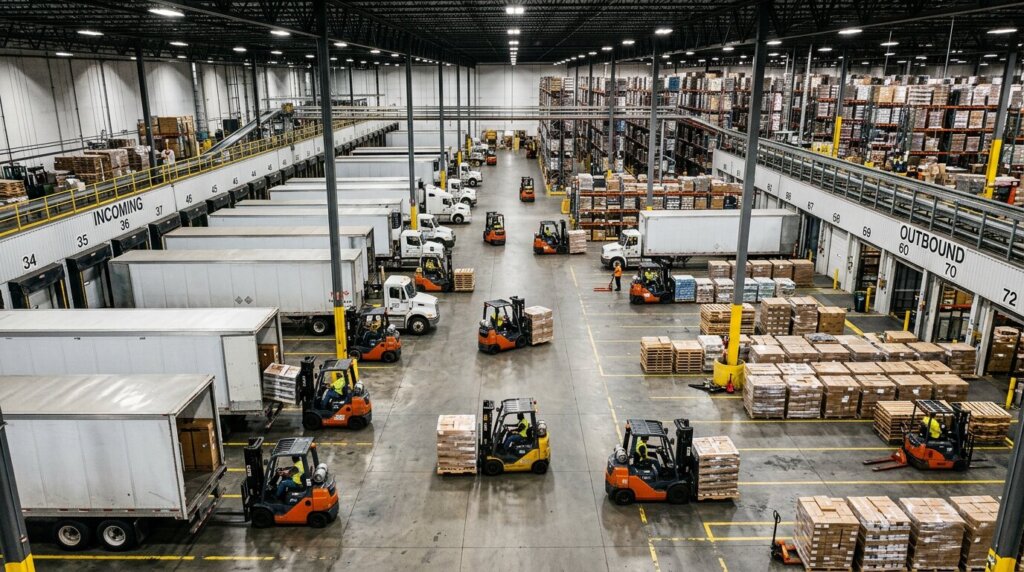
A truck unloads thirty pallets in half an hour. The goods are categorized in the receiving area, physically verified, and ready for cross-docking to the end customer. Yet, the digital reality tells a very different story: in the Warehouse Management System (WMS), these pallets are invisible.
This asynchronous dynamic is the root cause of logistics stagnation in cross-docking. When integrated logistics back-office outsourcing is missing, trucks and drivers frequently face long wait times at the docks simply because the administrative department’s data backlog prevents cargo authorization. Dispatchers and planners are forced to operate with blind spots. They see a dock that the system claims is still full of inbound freight, while the actual warehouse floor is empty. This lack of operational synchronization severely disrupts planned outbound flows.
The Pace Discrepancy on the Warehouse Floor
This contrast in speed fundamentally stems from the operational gap between mechanical movement and human data entry. Motorized pallet jacks and optimized floor routines accelerate the physical handling of goods. However, the accompanying paper trail—often a thick bundle of waybills, customs documents, and packing slips—travels to the logistics desk or back-office at a considerably slower pace. While the unloading crew is already tackling the next trailer, the documentation from the previous shipment sits waiting for manual triage and entry into systems like the WMS, FMS, or TMS.
Assessment: Is Your WMS Running Two Hours Behind?
Operational friction reveals itself through specific patterns on the warehouse floor. You can recognize a structural delay in data entry by observing these three systemic behaviors:
- Visual versus digital capacity: Planners redirect trucks to a different dock or a buffer lot because the WMS status overview shows an occupied loading dock, whereas a quick visual inspection proves the lane is completely clear.
- Physical location verification: Customer service representatives bypass the TMS entirely and call the inbound team leader directly to verify if an urgent shipment has actually been unloaded.
- Queues at the driver’s desk: Drivers whose cargo has long been physically positioned in the cross-dock crowd the window of the planning desk, waiting for their signed and processed paperwork so they can start their return trip or onward journey.
Three Specific Administrative Bottlenecks in Cross-Docking
Stagnation in the inbound process is driven by clear, identifiable sources. What appears on a macro level as general delay often traces back to highly specific hurdles in daily document processing. We regularly see how administrative bottlenecks slow down the physical supply chain during critical operational peaks.
1. Resolving Complex or Multilingual Documentation
Missing reference numbers and language barriers on packing slips actively dictate the pace at which the back-office can operate. With international shipments, transport documents arrive in various European languages and widely differing formats. Logistics administrative staff must manually interpret these, trace missing PO (Purchase Order) numbers through disconnected email threads, and carefully log exceptions. Every manual correction or search query required for data mapping disrupts the workflow. As a result, a document that should only take twenty seconds to process suddenly demands five minutes of investigative work.
2. Peak Times and Capacity for CMR and Customs Registration
The influx of inbound goods follows strict rhythms. Data flux heavily concentrates around the early morning hours and immediately after shift changes. During these peaks, multiple drivers arrive simultaneously carrying stacks of handwritten or partially damaged CMR waybills and complex customs documentation needed for import or export clearance. The local back-office headcount is rarely calibrated to handle this abrupt surge in workload. This creates an early bottleneck where an unprocessed stack of paper strictly limits the speed at which cross-docked goods achieve a ‘received’ status.
3. Delays in Availability Notifications
Within a tightly orchestrated cross-dock model, the availability notification acts as the primary trigger for outbound logistics. Only when an inbound shipment is comprehensively logged in the WMS does the software generate a task for the reach truck driver to move the pallet to the outbound loading dock. A sluggish onboarding of incoming data completely blocks this vital connection. The outbound truck sits ready, the pallet is waiting just twenty meters away, yet the lack of a digital clearance prevents loading.
The Financial Chain Reaction of Delayed Goods Receipt
Administrative friction immediately drains value from your logistics operation. Delays in data registration directly erode profit margins through a damaging combination of hard financial penalties and decreased efficiency per square meter. Carriers simply do not tolerate unplanned downtime. They aggressively pass on demurrage charges or waiting fees the moment a truck remains at the dock longer than the agreed time window. A dock blocked by an idle truck waiting for administrative clearance is a dock that cannot facilitate new cargo.
Calculation: The Real Cost of an Idle Loading Dock
Waiting time costs escalate rapidly when delays multiply across several docks and shifts. The transparent breakdown below illustrates the actual idle costs at a typical operational bottleneck:
| Cost Component | Calculation per hour per dock | Average Financial Impact |
|---|---|---|
| Demurrage / Truck Waiting Fees | Contractual carrier penalty per hour of downtime | € 45.00 – € 65.00 |
| Lost Cross-Dock Capacity | Missed throughput (avg. 12 pallets/hr x operational value) | € 30.00 – € 50.00 |
| Staff Inactivity | Idle outbound forklift driver & loader | € 35.00 – € 45.00 |
| Total Hidden Costs | Per delayed hour, per loading dock | € 110.00 – € 160.00 |
This calculation illustrates only the baseline inefficiency. When a mid-sized warehouse operates ten docks and generates thirty hours of cumulative administrative wait time daily, it results in direct margin compression amounting to thousands of euros every single week.
Scheduling Delays and SLA Breaches
Dynamic planning software relies entirely on steady, highly accurate data streams. Algorithms designed to optimize real-time routing and loading schedules perform poorly when foundational data is missing or out of date. Pallets that must be delivered to a distributor within a strict 24-hour cross-docking window miss their tight connections. The consequence: time-critical cargo is forced into overnight storage. This not only breaches Service Level Agreements (SLAs) with the client, but it also ties up expensive storage capacity in a facility explicitly engineered for continuous throughput, not long-term warehousing.
Operationally Decoupling Data Entry from the Physical Flow
The ultimate solution to these synchronization problems lies in fundamentally separating core tasks. Documentation does not require processing at the physical location of the goods. Once paperwork at the dock is digitally captured using high-speed industrial scanners or mobile devices equipped with Optical Character Recognition (OCR), data processing can immediately be routed to an external partner. This architecture definitively eliminates the documentation queue at the local planning desk and guarantees that warehouse staff can focus exclusively on physical logistics.
Time- and Location-Independent Operations Through Digitalization
A scalable Business Process Outsourcing (BPO) strategy intentionally shifts the administrative pressure to specialized teams. An external facility perfectly absorbs the peak moments and handles the complexities of multilingual data entry into platforms like a DMS or WMS. This modern model completely eliminates the impact of local back-office staff shortages. High-quality scans of freight documents enter secure workflows instantly, where data entry, validation, and complex mapping to customer orders are handled without delay. The on-site logistics process remains rapid and uninterrupted, while backend systems are updated in near real-time by a workforce that scales effortlessly alongside your dock volume.
Data Security: Why GDPR Remains the Benchmark for Outsourcing
Moving transport data—which habitually contains personal details, commercially sensitive loading lists, and strict customs information—carries heavy responsibilities regarding EU compliance. Offshoring to intercontinental destinations without legally anchored safeguards creates unacceptable security vulnerabilities.
A model lacking strict GDPR certification leaves enterprises chronically exposed to data breaches and devastating compliance fines. Operational continuity demands that processing stays absolutely within the borders and regulatory framework of the European Union. Partnering with a nearshoring provider—such as our facility in Romania—combines scalable capacity with unconditional legal security. This structure grants you the speed of a high-performance back-office safely anchored under European law, ensuring the highest standards of data accuracy and uncompromised security.
The profitability of a cross-docking operation hinges entirely on synchronized, high-quality information flows. Slow document processing leads organically to stagnating pallets, waiting trucks, and totally avoidable financial losses incurred through SLA breaches and demurrage. Decoupling physical transshipment from administrative processing via early digitalization breaks this destructive cycle for good.
Are you ready to structurally permanently solve capacity issues in your back-office and eliminate frustrating wait times at your docks? A specialized logistics back-office outsourcing partner like DataMondial acts as your highly scalable, inherently secure BPO ally, operating exclusively from EU-certified nearshoring facilities in Romania. Operating fully as a Dutch company, we integrate flawlessly into your operation, take over the slow-moving data entry tasks, and guarantee 100% GDPR compliance. Reach out to the specialists at DataMondial today to initiate your transition toward a perfectly synchronized logistics process.