Freight Invoice Auditing: In-House Capacity vs. Nearshore Expertise

Title: Freight Invoice Auditing: In-House Capacity vs. Nearshore Expertise Primary keyword: freight invoice auditing
Introduction: The complexity of manual freight invoicing
A transport operation is only truly successful when the financial settlement is fully resolved. In daily operations, planners frequently deal with freight invoices that deviate from the original purchase order. Unforeseen costs—such as waiting hours, a fluctuating Bunker Adjustment Factor (BAF), or revised toll charges—turn the auditing process into a time-consuming burden. Manually ticking off every invoice line distracts logistics personnel from their core responsibilities: capacity planning and relationship management.
Logistics providers face an operational dilemma. On one hand, flawlessly reconciling purchase and sales invoices demands strict control. On the other hand, recruiting specialized administrative staff locally is an expensive and arduous task. Shifting this invoice flow through [logistics back-office outsourcing](https://datamondial.com/en/diensten/remote-backoffice-voor-logistiek) to a specialized European back office provides a structural solution to data processing bottlenecks and margin erosion.
The hidden costs of in-house freight invoice auditing
Handling repetitive data management locally creates a skewed ratio between payroll costs and actual added value. Highly qualified freight forwarders spend hours chasing down invoice discrepancies. This internal process carries a direct operational risk: employee absenteeism or turnover immediately brings financial processing to a halt. Recruitment costs weigh heavily on the budget, while onboarding new staff slows down overall turnaround times.
Volume peaks expose the vulnerability of an in-house model. As soon as shipment numbers rise, operational friction increases in the office. This results in expensive overtime or being forced to skip crucial detailed checks. According to Sendcloud’s Invoice Check, twenty percent of transport invoices contain errors. When time pressure causes a forwarder to overlook thirty minutes of unjustified passed-on waiting hours (at €45 per hour), margins structurally leak away. With an influx of five hundred invoices a month, this lost profit quickly amounts to thousands of euros.
Impact of error margins and exceptions
The findings from the Sendcloud data demand action: one in five invoices requires immediate correction. Freight invoices are notorious for their complex surcharge structures. Demurrage and detention claims, currency fluctuations, and fuel surcharges frequently deviate from established framework contracts. Blindly accepting a discrepancy can reduce the gross margin of a trip below the break-even point. This calculation demonstrates that manual auditing under pressure leads to blind spots, resulting in direct, measurable financial loss.
Capacity challenges and fixed overhead
Logistics flows fluctuate by season. Synchronizing permanent staff with these swings creates friction. Scaling up fixed FTEs to absorb peaks places a heavy burden on overhead during quiet periods. Conversely, understaffing guarantees unchecked invoices and cash flow issues when volumes surge. The operational objective is to correctly and promptly reconcile the administration—without permanently increasing the payroll.
Nearshoring within the EU: Scalability without compliance risks
Structuring a logistics back office in Romania solves the capacity problem while maintaining exceptional data quality. This nearshoring model operates within the same European work culture and shares nearly the exact same time zone as the Netherlands. This entirely prevents the communication delays commonly associated with offshore models in Asia.
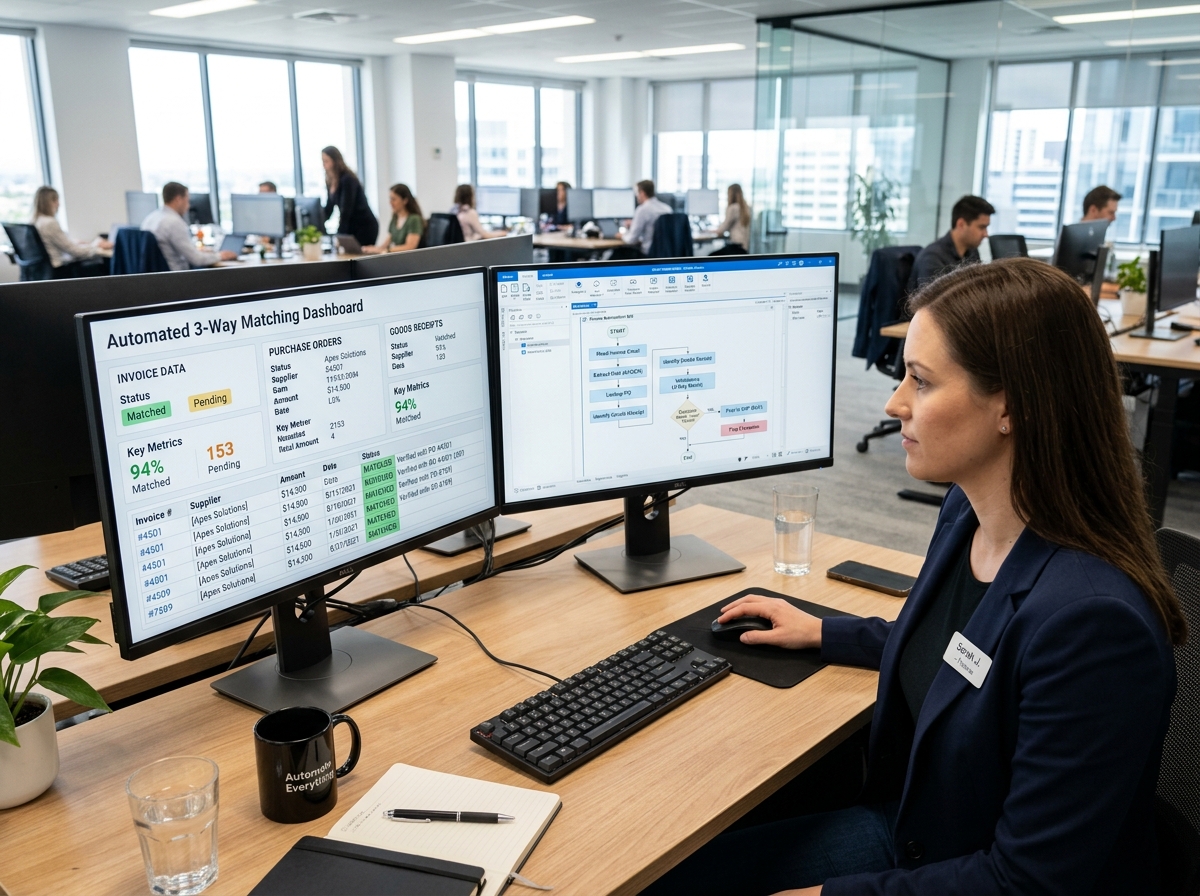
Operations rely on a hybrid structure: advanced technology processes the bulk, while human experts manage the exceptions. Robotic Process Automation (RPA) extracts data from incoming documents and automates repetitive entry. Highly trained Romanian data experts, operating under the guidance of Dutch management, immediately take the wheel as soon as the system flags a discrepancy.
Hybrid processing: RPA combined with domain expertise
Technology filters the workflow through strict ‘3-way matching’. The system cross-references the purchase order, the signed waybill (CMR), and the incoming freight invoice. If there is an exact match, the invoice is automatically approved. Human domain expertise steps in for the deviations. An unexplained damage claim or a fuel surcharge deviating from the indexation halts the automated process. The human expert analyzes the discrepancy and arranges the correction with the carrier or consults directly with your core planners.
Data security strictly tied to European regulations
B2B data transfers in logistics contain sensitive contractual agreements, freight rates, and customer data. Keeping this data within the borders of the European Union provides legal peace of mind. Nearshoring in Romania means all processing strictly complies with the General Data Protection Regulation (GDPR). The complex contractual setups required to safely park data outside the EU—as is necessary with offshore destinations—are obsolete. Corporate data remains completely protected by standard European privacy frameworks.
Decision matrix: When to keep it in-house or outsource out?
Outsourcing is a strategic choice driven by numerical facts. Business Process Outsourcing (BPO) delivers a strong ROI when dealing with high volumes, fluctuating invoice formats, and predictable capacity bottlenecks. There is a transparent threshold: nearshoring offers little added value for companies processing fewer than thirty highly standardized invoices a week. Below that volume, the setup and implementation costs simply don’t outweigh the hours saved.
Criteria for internal processing
Local processing remains the logical route for very low invoice volumes coupled with a zero-tolerance policy for process change. If invoices consist of just a few lines without variable surcharges, and current administration handles them within regular hours without disrupting core capabilities, outsourcing yields no immediate operational advantage.
Evaluation framework: In-house versus Nearshore
Offsetting fixed personnel costs against variable processing costs highlights the deep financial and operational differences. The table below provides a comparison between both models based on cost structure, control mechanisms, flexibility, and compliance.
| Criterion | In-house processing | Nearshore BPO (EU) |
|---|---|---|
| Cost per invoice | High (tied to fixed FTE salaries) | Low (variable or output-based) |
| Quality control | Susceptible to time pressure and human error | Standardized via a hybrid RPA model |
| Scalability during peaks | Low (risk of backlogs or expensive overtime) | High (flexible deployment of trained teams) |
| Data security compliance | Managed locally according to company policy | Fully GDPR-compliant within the EU framework |
Choose a scalable structure
Strict 3-way matching and robust freight invoice auditing protect your transport margins from escalating surcharges and revenue leakage. By shifting this invoice control to a nearshoring partner, you significantly relieve recruitment pressure and transform fixed labor costs into a highly scalable invoicing capability. Discover how to increase data accuracy and systematically offload your internal planners by efficiently setting up your [logistics back-office outsourcing with DataMondial](https://datamondial.com/en/diensten/remote-backoffice-voor-logistiek).