Flawed RPA Extractions in Customs Documents: A Ticking Compliance Time Bomb

Introduction: Why Unchecked Speed Erodes Compliance Margins
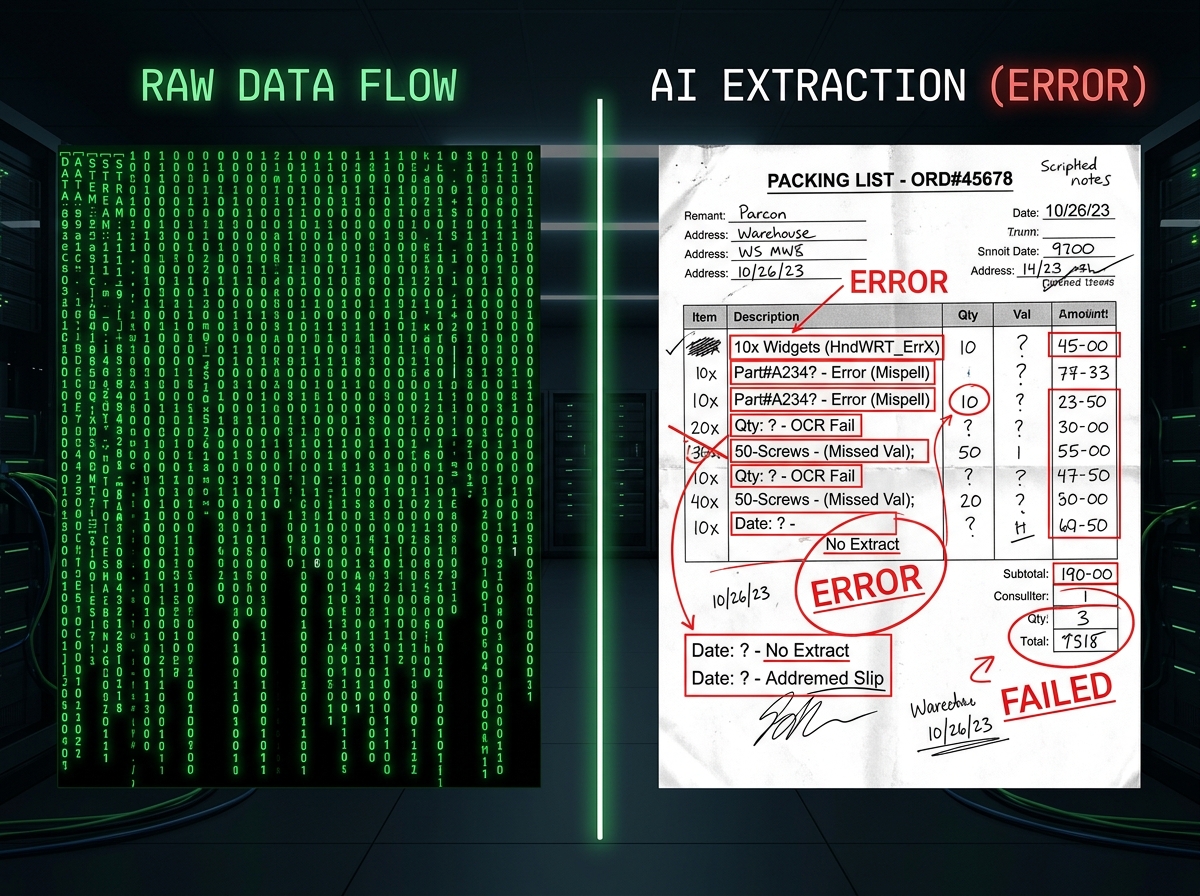
In practice, automating customs documents often clashes head-on with legal accuracy requirements. While automation accelerates your workflow, customs authorities evaluate submissions based purely on factual accuracy. Fully automated document processing that relies on unmonitored algorithms introduces structural data issues. These algorithms extract characters at lightning speed, but they completely fail to interpret the logistical context.
When a system feeds unvalidated extraction errors directly into a declaration system, document mismatches are inevitable. Customs authorities have zero tolerance for error margins—they respond with sanctions. The promise of a ‘zero-touch’ data-entry process delivers sheer time savings, but simultaneously hollows out your compliance margins. This disconnect between IT infrastructure and customs legislation forces logistics executives to fundamentally rethink their data entry strategies.
The Blind Spots of Generic OCR in Customs Documentation
Standard automation technology struggles with international trade documents due to a fundamental lack of standardization. A commercial invoice from Asia shares absolutely no design architecture with a packing list from South America. Generic OCR (Optical Character Recognition) relies on fixed coordinates. The moment a data field shifts out of position, data extraction derails.
This technology fails when confronted with the physical reality of paper workflows. OCR software frequently misreads the number zero (‘0’) as the capital letter ‘O’. In standard administration, this is a simple typo; in customs classifications, however, this exact mix-up counts as a critical violation. The engine forces an interpretation based on available pixels, recognizes a shape, and blindly pushes the incorrect value down the Robotic Process Automation (RPA) pipeline.
Variable Layouts and Physical Stamps as Disruptors
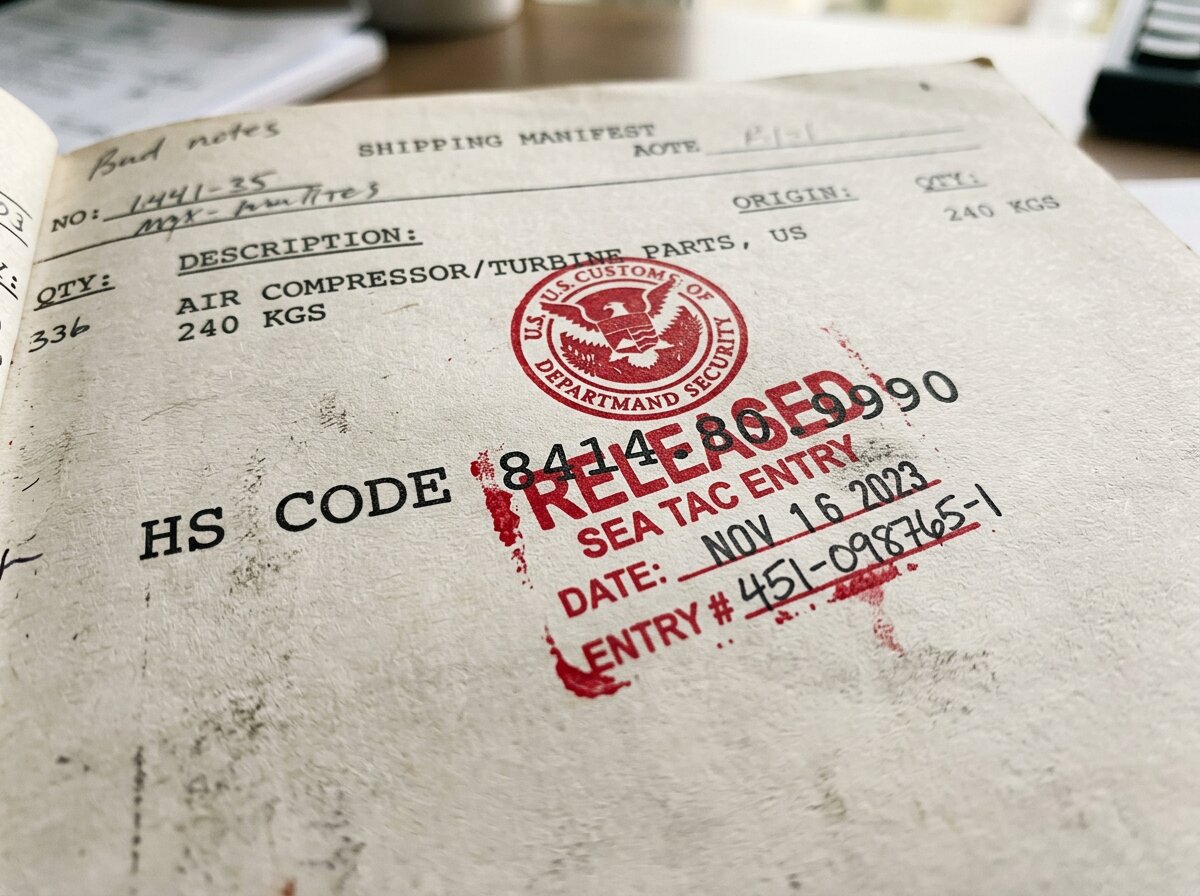
Basic RPA architecture relies entirely on predictable patterns. Yet, logistics documents like certificates of origin and waybills constantly disrupt these patterns through physical handling. Customs officers or warehouse personnel frequently place wet ink stamps, scribbles, or checkmarks over typed text. A stamp partially printed over the gross weight generates visual noise. The RPA software categorizes these overlapping layers of ink as unrecognizable symbols or wrongly merges characters. A skewed scan or a crease in the paper triggers the exact same failure mechanism. Consequently, the software extracts a corrupted string of characters that contaminates underlying logistics systems.
Case Study: The Financial Impact of a Single Misread Character
The vulnerability of unchecked RPA becomes painfully clear with HS (Harmonized System) codes. Imagine a freight forwarder importing cargo with the correct HS code ‘8471 30 00’. Due to slight fading on a scanned packing list, the OCR misreads the last two zeros, processing the code as ‘8471 30 OO’ or truncating the unreadable section entirely to ‘8471 30’.
Because data buffers sometimes accept arbitrary alphanumeric combinations, the error slips through the gate. The customs system receives a declaration for a completely different—or partially non-existent—commodity category. Suddenly, a duty-free IT component is reclassified as a product subject to heavy import duties and anti-dumping measures. An unjustified tax assessment follows. Correcting these erroneous declarations after the fact drains operational hours, triggers legal procedures, and often requires placing financial deposits just to get the shipment released.
Three Acute Compliance Risks of Unmonitored Extractions
From a COO’s perspective, an unmonitored RPA workflow poses a creeping threat to operations. The declarant remains legally and financially liable for data accuracy at all times, regardless of failing internal software. Three severe business risks immediately emerge when algorithms are given free rein over document streams.
Risk 1: Direct Levies from Incorrect Tariffs
Customs authorities settle incorrect classifications directly with the license holder. A misinterpreted HS code leads to assessments under the wrong tax rate, resulting in retrospective levies for the importer or the advancing freight forwarder. Authorities issue fines per declaration. Consequently, a seemingly minor OCR error margin of two to three percent on the total volume escalates into a financial loss that can completely wipe out the monthly profit margin on customs operations.
Risk 2: Elevated Risk Profiles and Physical Inspections
The Customs IT system runs on risk models and pattern recognition. Algorithms actively monitor the data quality of every declarant. A continuous stream of data inconsistencies, or systematic post-declaration rectifications, drives up your company’s risk score. A high risk profile triggers inspection protocols, subjecting your business to intensive customs audits—such as mandatory physical inspections of containers in warehouses. The resulting logistical standstill causes demurrage and detention charges, severely disrupting the end-customer’s supply chain.
Risk 3: Forced Loss of AEO Status
The Authorized Economic Operator (AEO) status guarantees preferential logistics trade conditions. Authorities grant this certificate exclusively to organizations with ironclad procedures regarding data security and process control. An official audit will mercilessly expose when flawed RPA loops result in corrupt files. Customs officers have the authority to suspend AEO certification in cases of persistently failing oversight. Losing this status forces freight into much slower, standard border procedures.
When Pure RPA is Unsuitable for Data Processing
Defining the limits of standalone technology prevents unworkable integrations, operating under the principle of ‘this does not apply when’. An IT infrastructure based on 100% autonomous processing simply cannot perform when handling PDF scans and physical paper workflows, due to the shifting morphology of these source files. Human intervention—via ‘exception handling’—is absolutely mandatory for this type of documentation to ensure compliance.
This vulnerability, however, disappears completely with end-to-end EDI (Electronic Data Interchange) connections. Pure EDI lacks any visual element. Systems communicate digitally using fixed XML or JSON structures. The technology imports raw data directly into predefined fields, effectively eliminating interpretation errors. Pure RPA is highly reliable when operating on structured EDI, but it chronically stumbles over visual files.
The Distinction Between Structured EDI and Variable Scans
The nature of your data source should dictate your processing strategy. Standalone software implementations fail to adequately cover the information flow when trade partners insist on email attachments and digitized paper. The technical comparison below outlines the parameters and explains why pure software solutions fall short with traditional data carriers.
| Feature | End-to-end EDI | PDF & Paper Scans |
|---|---|---|
| Source Format | Structured fields (XML, JSON, EDIFACT) | Visual pixels, variable templates |
| Data Extraction Method | API connection or software mapping | Optical Character Recognition (OCR) |
| Data Failure Risk | Zero (hard static values) | Present due to scan quality, typography, and stamps |
| Required Control Level | Built-in logical IT controls | Hybrid workflow: Extraction plus ‘Human-in-the-loop’ validation |
| Pure RPA Suitability | Suitable and safely executable | Compliance risk due to missing context |
Summary & Next Steps
The design of logistics data processes breaks down when companies force fast algorithms onto visually inconsistent customs forms. Flawed RPA extractions cause unjustified levies, operational stagnation, and actively jeopardize critical certifications. Bridge this data gap through specialized solutions that guarantee genuine process improvement. Explore the possibilities of a hybrid validation approach, where advanced RPA is safely calibrated with expert human validation from the EU-compliant BPO specialist DataMondial, coordinated directly from our ISO-certified nearshoring center in Romania.