The 5-Step Roadmap for a Flawless Back-Office Outsourcing Transition in Supply Chain

Introduction: Risk Management for Data Transitions in Logistics
Inaccurate data entry during freight handling directly results in idle trucks and customs bottlenecks. Any friction when transferring logistics back-office processes creates an operational risk that disrupts the entire supply chain. A strategic approach to back-office outsourcing is the solution. It relies on a strictly orchestrated, phased migration of data flows based on a controlled 5-step roadmap. This framework structures the transition, breaking the handover down both technically and procedurally to minimize workplace disruptions. However, there is one non-negotiable operational prerequisite: this transition plan only works with fully digitized cloud processes. Legacy systems and paper-driven workflows must be modernized before a BPO (Business Process Outsourcing) migration can successfully launch.
Step 1: Process Inventory and Baseline Measurement
Quantifiable goals prevent post-go-live disputes. A secure integration of back-office outsourcing in the logistics sector begins with establishing a hard, data-driven baseline. Define the scope immediately down to the document level. Decide whether the transition will start with internal transport manifests, international waybills, or customs documentation. As stated by insourcing and outsourcing specialists at Groenewout, an IT capacity analysis is the absolute foundation for successfully exporting workflows. Use logs from your existing ERP or WMS systems to measure the current turnaround time per type of transport document, noting the percentage of internal corrections and errors. This baseline forms the foundation upon which your Service Level Agreements (SLAs) are built. In parallel, your network administrator must map out which point-to-point VPN protocols are required to grant the nearshoring partner secure and controlled system access.
Documenting Current System Integrations
Before the nearshoring team steps in, your IT architecture must be configured to collaborate with external IP addresses. Map out which API connections, cloud applications, and databases (such as container tracking systems) are impacted by the outsourced process. Specify role-based access controls for all external operators via Identity and Access Management (IAM). This segmentation ensures that data entry specialists do not gain visibility into financial ledgers or HR systems outside their strictly defined scope of work.
Step 2: Knowledge Retention and Standard Operating Procedures (SOPs)
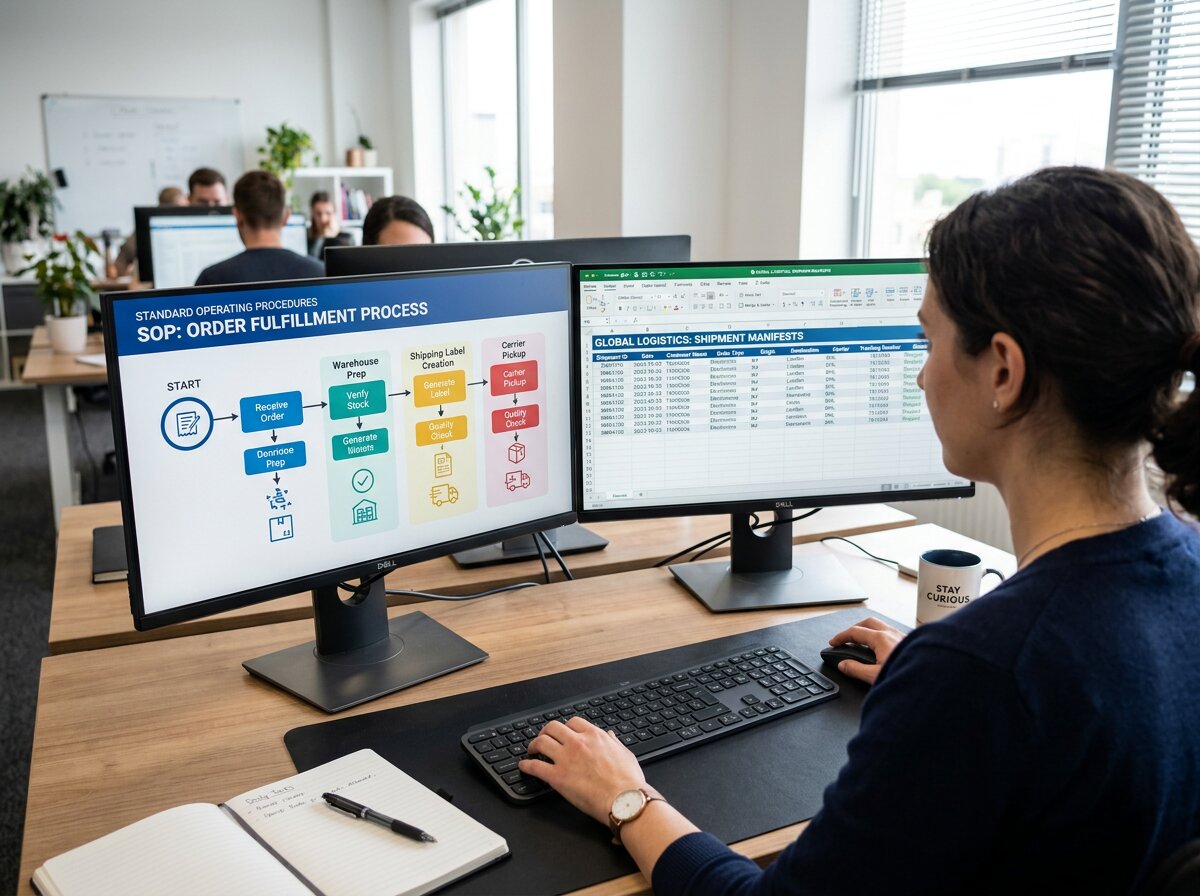
Implicit tribal knowledge slows down migrations. Unwritten departmental rules—such as a transport planner’s habit of calculating missing weights based on historical client records—must be documented. Translate these actions into strict Standard Operating Procedures (SOPs). Writing out instructions isn’t enough; record processes via screen captures and add arrows and annotations to video files to highlight unusual database fields. Detailed manuals immediately increase operational shipping accuracy. This methodology leads to measurable quality gains, as analyzed in Sourcefit’s research on logistics and transport outsourcing. Furthermore, short lines of communication prevent minor queries from snowballing into supply chain delays. Centralize consultation and feedback through dedicated client success managers operating in the same time zone as your headquarters.
Setting Up an Escalation Matrix
Disruptions in customs processing demand immediate action from authorized personnel. Establish an escalation matrix outlining exactly who makes decisions when an external operator encounters a missing or incorrect HS code. The hierarchy follows a strict protocol. First, the operator consults their team leader at the nearshoring facility in Romania. If unresolvable, the BPO team leader escalates to management or the lead planner at the Dutch headquarters. These agreements streamline the process and eliminate waiting times when handling operational exceptions.
Step 3: Shadowing in a Parallel Work Environment
Risk management in data entry truly takes shape during the shadowing phase. Place certified specialists in an isolated IT environment and have them process the daily flow of logistics documents in parallel with your internal team. Compare their output against the indicators established during your baseline measurement: processing speed on one side, and data accuracy on the other. In this sandbox model, the contracted partner deliberately has the space to make mistakes on complex freight calculations or container bookings. Actual operational freight handling remains completely unaffected. Every discrepancy serves as direct input to refine your SOP manuals. This model validates the advantage of partnering with a Dutch company that manages operations within a physical nearshoring facility in Romania. The combination of local management and strict EU compliance guarantees that privacy-sensitive data never crosses European borders in violation of GDPR guidelines.
Step 4: Phased Go-Live per Department
A sudden, system-wide handover of all documentation flows usually forces operational bottlenecks. Instead, execute the go-live incrementally. Start with internal or less time-critical document feeds, such as storage billing, before shifting the handover to T1 customs documents or export waybills where drivers are physically waiting. Link the go-live to a daily, tightly scheduled video evaluation between team leaders to verify the delivered datasets.
By offloading repetitive data entry, internal supply chain planners transition into an operational auditing role. Logistics expert Transalliance describes this tactic as the golden rule for enforcing “retention of internal control” by separating execution from verification. The client manages the framework and exceptions; the BPO partner handles the processing volume. When outsourcing logistics and transport, companies that apply this phased handover succeed much faster. This was clearly demonstrated by Deutsche Bank’s six-week structured outsourcing approach, featured in Financieel Management on procurement outsourcing.
Timeline for a Standard Transition Cycle
| Transition Week | Operational Focus | Internal Department Actions | BPO Partner Actions |
|---|---|---|---|
| Week 1 | Passive observation | Process current data; provide test cases via the sandbox. | Shadow operators; study and translate SOPs. |
| Week 2 | Shadowing | Controlled sampling of the isolated shadow output. | Independent processing in a test environment (sandbox). |
| Week 3 | Partial go-live | Audit all external data entry in the live system (100% check). | Process 50% of the actual operational caseload. |
| Week 4 | Operations handover | Switch to periodic quality audits. | Full takeover of the specific document flow (100% processing). |
Step 5: Evaluation and RPA Integration
Immediately following the handover phase, the project manager evaluates the BPO specialists’ actual processing times against the baseline measurement. Stable, fully standardized, and successfully transitioned processes then pave the way for targeted technological scalability. Evaluate whether fixed, highly repetitive tasks—like extracting fields from standard supply chain invoices—qualify for Robotic Process Automation (RPA).
Implement these software bots within a controlled “human-in-the-loop” ecosystem. Models where technology blindly takes over will fail the moment OCR scanning errors occur or when a customs field requires manual intervention. Extraction bots prepare the raw logistics data; human specialists validate complex exceptions. Wherever the software falters due to non-standard file formats, the human operator team immediately steps in. This configuration aligns with industry best practices, blending human insight with technological processing speed to maximize operational efficiency.
Conclusion: Guarantee Continuity Through an Orchestrated Handover
The impact of data migrations on logistics planning remains manageable when execution is driven by targeted shadow testing and compartmentalized rollouts. Absorbing back-office peaks and controlling information flows requires measurable protocols and highly reliable nearshore facilities operating under EU computing jurisdictions. By integrating human oversight into clearly defined stages, an organization lowers its structural error margin without bringing the workplace to a halt. Safeguard the continuity of your supply chain with our proven onboarding framework for back-office outsourcing. Request a no-obligation process scan from Data Mondial, and discover exactly how viable outsourcing is for your back-office needs.
“`