The Hidden Financial Leak of Blind Processing: How Unnoticed AI Errors Erode Logistics Margins

For financial directors in the logistics sector, implementing automated invoice processing offers a direct route to lower operational costs. Software packages promise high levels of automation through Optical Character Recognition (OCR) and AI. However, reality paints a different picture once transport documentation enters the system. Blind processing—where an invoice flows through the Enterprise Resource Planning (ERP) system from receipt to payment without human intervention—creates an invisible financial leak. Specific data validation for OCR, AI, and machine learning is essential, as data extraction errors quietly bypass system thresholds, resulting in structural overpayments to suppliers and carriers.
The Pitfall of 95 Percent OCR Accuracy
AI invoice automation reads standard fields—like supplier names and standard VAT amounts—with impressive precision. The logistics sector, however, relies on complex documents filled with nuances, such as surcharges, tolls, and handwritten corrections. A 95 percent recognition rate looks like a successful implementation, raises few questions during management meetings, and justifies the software investment. Yet, at high volumes, that remaining 5 percent error margin takes a direct hit on net profit margins.
Recent benchmark data on OCR accuracy for handwritten fields confirms that the probability of error increases exponentially when characters fall outside fixed templates or overlap. A waybill (CMR) or an invoice full of exceptions forces the algorithm into contextual guesswork, leading to unexpected interpretation errors in critical amounts. Maintain your AI accuracy even when document flows increase exponentially.
Error Margins in Perspective: The Financial Math
The impact of these errors demands a closer look at the numbers. Consider a logistics service provider or shipper processing 10,000 incoming freight invoices per month. With an uncontrolled OCR error margin of 5 percent, 500 invoices containing anomalous data enter the ERP system.
If a misread currency symbol, an unjustified fuel surcharge, or a misinterpreted weight leads to an average overpayment of €40 per flawed invoice, exactly €20,000 leaks away every month. Annually, this totals a €240,000 loss that remains completely under the radar of routine audits, simply because the system classifies the payments as legitimate based on incorrectly extracted source data.
Why Real-World Waybills Mislead the Software
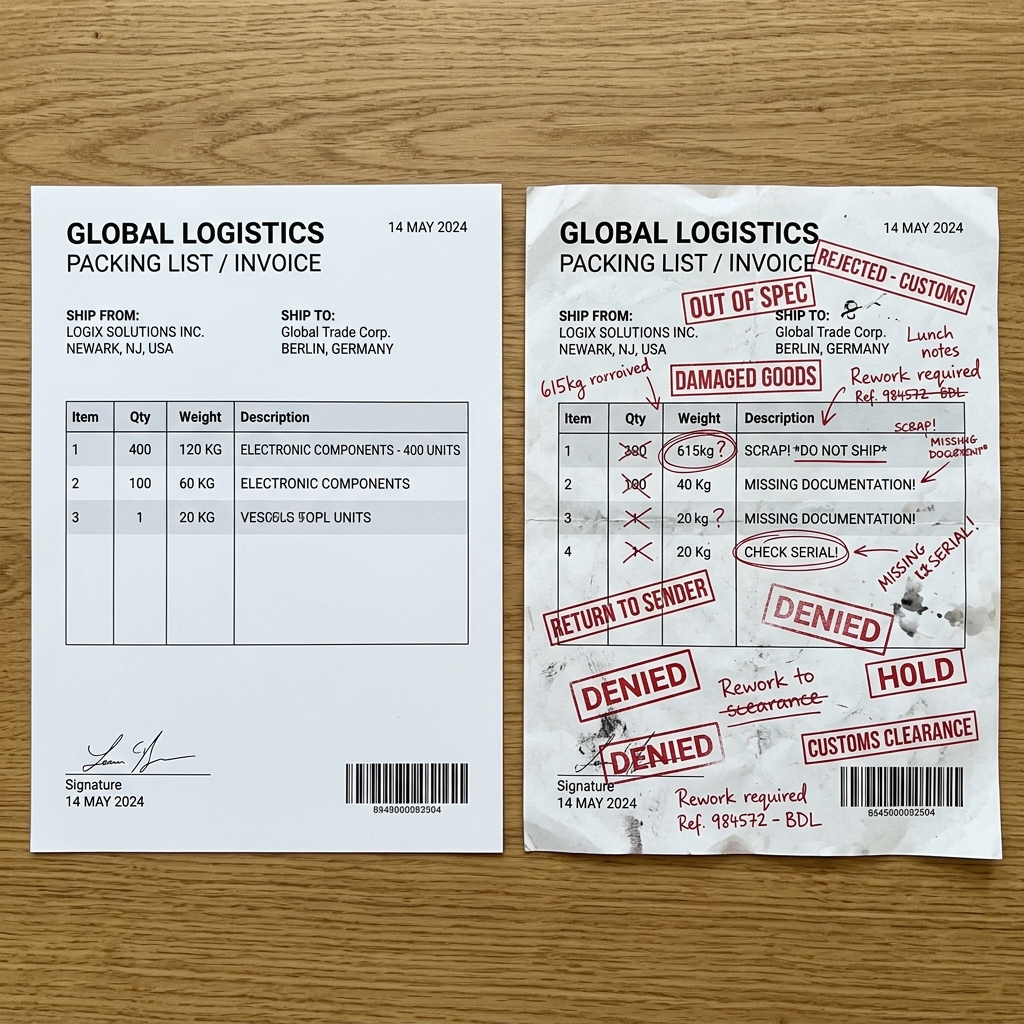
Waybills pose a unique challenge for pattern recognition. Drivers and warehouse staff apply stamps, cross out fields, and scribble manual notes directly over printed text. A customs stamp over the gross weight field disrupts the visual contrast. A handwritten ‘x’ marking damaged goods is misread by the software as part of a reference number.
These alterations to physical documents drastically reduce the extraction accuracy of a CMR. Because algorithms are programmed to populate a field no matter what, the software often selects the nearest visible number on the page when faced with unreadable text. In an instant, a trip number transforms into an invoice amount.
Where Things Go Wrong: 3 Common Reading Errors on Freight Invoices
Field research indicates that poor document quality doesn’t just reduce AI extraction accuracy evenly across all fields; it strikes disproportionately at the most complex logistics variables. Programmed rules fail to catch these contextual errors. Three specific categories cause the lion’s share of the financial damage.
Issue 1: Misinterpreting Currencies
Parsing currency symbols incorrectly is a direct threat to liquidity. Transport invoices from the UK contain pound signs (£), whereas invoices from the EU or Switzerland reference euros (€) or Swiss francs (CHF).
Due to low scan resolutions or slight ink fading, OCR systems can easily misinterpret a pound sign as a euro sign. Consequently, an invoice totaling £5,000 lands in the payment batch as €5,000. The ERP system merely checks the math (net plus VAT equals total) and approves the invoice. Without human validation or mandatory checks based on country code templates, this instantly results in an incorrect net payment to an international carrier.
Issue 2: Cost Interpretation for Demurrage and Detention
Demurrage and detention charges in sea freight, or storage costs at distribution centers, are strictly time-bound. Ocean carriers and terminals send invoices featuring various date formats, depending on the origin country’s accounting software. US carriers use the MM-DD-YYYY format, while European recipients operate on DD-MM-YYYY.
If a container is exempt from charges until the fifth of the fourth month (05-04-2024, exactly April 5), an uncalibrated OCR might read the date as May 4. Should the container be returned on April 12, the system incorrectly triggers weeks of storage charges. The underlying calculation logic applies the data correctly but accepts a flawed starting date as truth, thereby legitimizing non-existent storage fees.
Issue 3: Duplicate Detection Failure Due to Deviating References
Duplicate payments represent a persistent issue when suppliers send reminders or copy invoices via email. ERP systems fend off duplicates by cross-referencing the invoice number and supplier ID. However, minor extraction variations easily bypass this programmed barricade.
A reference number like “INV-88902A” is protected, provided the system reproduces it exactly. But if the OCR accidentally adds a space (“INV- 88902 A”) due to a crease in the paper, or misses the letter ‘A’, the software classifies the document as a new, unpaid item. For recurring services with identical weekly amounts, such an approval goes completely unnoticed. The invoice passes the validation rules flawlessly, and the carrier gets paid twice.
When Blind Processing Backfires
Technology is only as effective as its parameters allow. Blind processing—also known as straight-through processing or zero-touch handling—functions effectively for solid framework agreements. Routine deliveries with fixed monthly subscription costs and predictable data fields are perfectly suited for total automation. But as procurement complexity rises, this approach quickly morphs into a risk factor.
Eliminating human spot checks entirely frustrates the technological chain. Machine learning algorithms require structural corrections to improve pattern recognition. Without targeted human oversight, essential feedback loops vanish. Algorithms that structurally mistranslate a specific abbreviation or handwriting style will simply repeat the error endlessly until a user manually course-corrects the model.
Contract Invoices vs. Fluctuating Spot Prices
The dividing line for automation lies exactly at the edge of predictability. For freight prices locked in through long-term tenders, the software simply verifies whether the invoiced line matches the agreed tariff in the procurement system.
The spot market lacks these rigid anchors. Transport rates fluctuate based on seasonality, equipment availability, and current fuel surcharges. Extra costs for wait times at offloading sites, variable toll rates, or hazardous materials (ADR) surcharges make every spot invoice unique. When managing freight invoices, an algorithm often has no baseline to verify these variable amounts against. Allowing these highly volatile invoice types to pass blindly through the approval process results in a complete loss of control over price deviations.
Checklist: Invoice Types to Exclude from Blind Processing
Finance departments need to implement clear segmentation in their document workflows. The following freight and invoice types should inherently trigger a manual flag before entering the system:
- Spot market transport invoices: Any invoice without a linked, fixed purchase order or framework agreement.
- Customs and import duty invoices: Complex structures featuring varying VAT regimes and advanced levies.
- Demurrage, detention, and storage: Bills based on external time registrations that differ from internal tracking systems.
- Invoices with handwritten corrections: Documents related to cargo damage or temperature deviations.
- Additional work or overtime: Time accounting tied to manual unloading or repacking.
From Reactive Crediting to Proactive Filtering
Correcting automated oversights burns an outsized amount of the finance department’s capacity. The focus must shift from detecting payment errors at the end of the cycle to enforcing a robust validation process at the front end.
The cost of an additional control step before data flows into the software is ultimately just a fraction of the hours spent on the back end trying to recover lost capital. By pairing human intelligence with the processing speed of RPA (Robotic Process Automation), organizations can create a scalable model that eliminates error margins without sacrificing efficiency.
The High Hidden Cost of Chasing Credit Notes
Performing retroactive debt collection on paid invoices is financially disastrous. As soon as an accountant or business controller detects a pattern of unjust surcharges, an escalation process begins.
An employee hunts for the original workflow, analyzes the faulty calculation, calls or emails the carrier to substantiate the claim, and requests a credit note. The supplier must then investigate the claim and process the credit in their own ledgers. During these weeks or months, capital is tied up, liquidity drops, and the process devours costly man-hours. Setting up a definitive front-door control process prevents this cycle entirely, ensuring pure net outward cash flows.
Integrating Targeted Human-in-the-Loop Frameworks
The building blocks of data accuracy demand a human-in-the-loop structure. Software is configured with specific threshold values. When an invoice exceeds a deviation tolerance of, say, three percent, contains unprecedented fuel surcharges, or features a scan resolution lower than expected, the programming forces the system to halt.
The invoice is routed to an exceptions queue. This process requires human back-office bandwidth to manually validate anomalies. During peak seasons, handling this in-house rapidly leads to processing delays and bottlenecks in payment terms. Outsourcing this visual control grants organizations the exact scalability they need.
By deploying external nearshore support for this blocked workflow, companies minimize peak loads on their internal teams. Validation is executed by trained operators possessing deep logistics domain knowledge. This guarantees that prioritizing data accuracy won’t stall the supply chain, ensuring business continuity while feeding your internal AI system the exact corrective input it needs to perfect its learning cycle.
Financial leakage through the blind acceptance of AI invoice automation represents a very real threat to operational logistics processes. Lacking visibility into actual reading errors on complex waybills and transport tariffs, systems blindly approve wrong currencies, faulty timeframes, and duplicate invoices. To protect your margins, the industry focus is shifting from blind processing toward systems equipped with smarter thresholds and proactive, trained data control at the gate. Integrating specialists guarantees that your RPA and AI systems are flawlessly fed with 100% accurate data. Discover how DataMondial’s reliable data validation for OCR can unburden you, delivering flawless logistics administration and ultimate scalability. Contact us to schedule a targeted consultation.